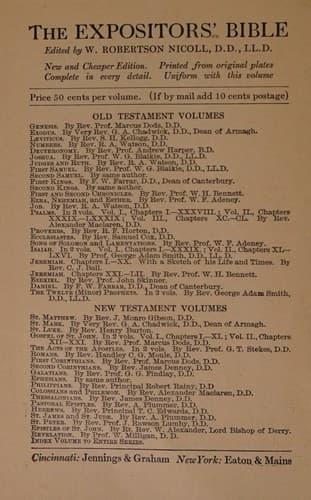
The Expositor's Bible: The Book of RevelationMilligan, William
Philosophy
The Expositor's Bible: The Book of Revelation
Milligan, William
Bible. Revelation -- Commentaries
presents the two classes as if they were divided from each other by a
permanent wall of separation, and as if the work of Christ consisted not
so much in bringing the one class over to the other as in making
manifest the existing tendencies of each. The light of the one
brightens, the darkness of the other deepens, as we proceed; but the
light does not become darkness, and the darkness does not become
light.[594]
Hence, accordingly, the conversion of Israel or of the heathen finds
no place in the Apocalypse. The texts supposed to offer such a
prospect will not bear the interpretation put upon them. It does not
indeed follow that, according to the teaching of this book, neither
Israel nor the heathen will be converted. St. John only sees the end
in the beginning, and deals, not with the everyday practical, but with
the ideal and everlasting, issues of God's kingdom. Hence, in
interpreting the words before us, we must be careful to put into them
the exact shade of meaning which the whole spirit and tone of the
Apostle's writings prove to have been in his mind when they were
written. The clauses "He that is unrighteous" and "He that is filthy"
are to be understood as "He that has loved and chosen unrighteousness
and filthiness:" the clauses "Let him do unrighteousness still" and
"Let him be made filthy still" as "Let him sink deeper into the
unrighteousness and filthiness which he has loved and chosen." A
principle freely selected by himself is supposed to be in the breast
of each, and that principle does not remain fixed and stationary. No
principle does. It unfolds or develops itself according to its own
nature, rising to greater heights of good if it be good, sinking to
greater depths of evil if it be evil. Hence also we are not to imagine
that the words under consideration are applicable only to the end, or
are the record only of a final judgment. They are applicable to the
Church and to the world throughout the whole course of their
respective histories, and it is at this moment as true as it will ever
be that, in so far as the heart and will of a man are really turned to
evil or to good, the allegiance he has chosen has the tendency of
continued progress towards the triumph of the one or of the other.
Public-domain text, read in full here on John Shaqi.
Reviews
Reviews
No reviews yet
Be the first to share your thoughts on this work.
Elsewhere in the archive
Join the Discussion
Join the discussion
Sign in to leave a comment or review.
Sign InorCreate an account