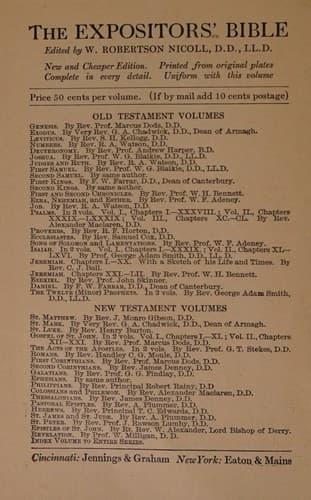
The Expositor's Bible: The Book of RevelationMilligan, William
Philosophy
The Expositor's Bible: The Book of Revelation
Milligan, William
Bible. Revelation -- Commentaries
And when He opened the fourth seal, I heard the voice of the
fourth living creature saying, Come. And I saw, and behold a pale
horse: and he that sat upon him, his name was Death; and Hades
followed with him. And there was given unto them authority over
the fourth part of the earth, to kill with sword, and with famine,
and with death, and by the wild beasts of the earth (vi. 7, 8).
The colour of the fourth horse is _pale_; it has the livid colour of a
corpse, corresponding to its rider, whose name, Death, is in this case
given. _Hades followed with him_, not after him, thus showing that a
gloomy and dark region beyond the grave is his inseparable attendant,
and that it too is an instrument of God's wrath. In chap. i. 18 these
two dire companions had also been associated with one another; and it
is important to notice the combination, as the fact will afterwards
throw light upon one of the most difficult visions of the book.
"Death" is not neutral death, that separation between soul and body
which awaits every individual of the human family until the Saviour
comes. It is death in the deeper meaning which it so often bears in
Scripture, and especially in the writings of St. John,--death as
judgment. In like manner Hades is not the neutral grave where the rich
and the poor meet together, where the wicked cease from troubling, and
where the weary are at rest. It is the region occupied by those who
have not found life in Christ; and, not less than death, it is
judgment. "Death" and "Hades" then are the culminating judgments of
God upon _the earth_, that is, upon the wicked; and they execute their
mission in a fourfold manner: by _the sword, and famine, and death,
and the wild beasts of the earth_. The world, the symbolical number of
which is four, instead of blessing such as submit themselves to its
sway, turns round upon them with all the powers at its command and
kills them. The wicked "are sunk down in the pit that they made: in
the net which they hid is their own foot taken."[142]
It is not easy to say why authority is given death and Hades over no
more than _the fourth part_ of the earth, when we might rather have
expected that their dominion would be extended over the whole. The
question may be asked whether it is possible so to understand the Seer
as to connect a "fourth part" of the earth, not with all the
instruments together, but with each separate instrument of judgment
afterwards named--one fourth to be killed with the sword, a second
with famine, a third with death, and a fourth by wild beasts. Should
such an idea be regarded as untenable, the probability is that a
fourth part is mentioned in order to make room for the climactic rise
to a "third part" afterwards met under the trumpet judgments.
Public-domain text, read in full here on John Shaqi.
Reviews
Reviews
No reviews yet
Be the first to share your thoughts on this work.
Elsewhere in the archive
Join the Discussion
Join the discussion
Sign in to leave a comment or review.
Sign InorCreate an account