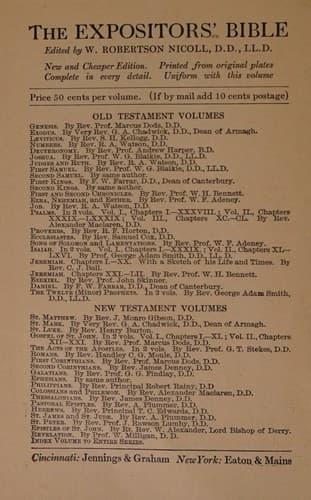
The Expositor's Bible: The Book of RevelationMilligan, William
Philosophy
The Expositor's Bible: The Book of Revelation
Milligan, William
Bible. Revelation -- Commentaries
While, however, the truth of these words may be allowed, it is still
necessary to urge that the primary application of the language of the
sixth Seal is to no one of such events in particular, but to something
which includes them all. In other words, it applies to the Christian
dispensation, viewed in its beginning, its progress, and its end,
viewed in all those issues which it produces in the world, but
especially on the side of judgment.
Nor ought such dark and terrible figures to startle us, as if they
could not be suitably applied to a dispensation of mercy, of grace
that we cannot fathom, of love that passeth knowledge. The Christian
dispensation is not effeminacy. If it tells of abounding compassion
for the sinner, it tells also of fire, and hail, and vapour of smoke
for the sin. If it speaks at one time in a gentle voice, it speaks at
another in a voice of thunder; and, when the latter is rightly
listened to, the air is cleared as by the whirlwind.
Although, therefore, the language of the prophets and of this passage
may at first sight appear to be marked by far too great a measure both
of strength and of severity to make it applicable to the Gospel age, it
is in reality neither too strong nor too severe. It is at variance only
with the verdict of that superficial glance which is satisfied with
looking at phenomena in their outward and temporary aspect, and which
declines to penetrate into the heart of things. So long as man is
content with such a spirit, he is naturally enough unstirred by any
powerful emotion; and he can only say that words of prophetic fire are
words of exaggeration and of false enthusiasm. But no sooner does he
catch that spirit of the Bible which brings him into contact with
eternal verities than his tone changes. He can no longer rest upon the
surface. He can no longer dismiss the thought of mighty issues at stake
around him with the reflection that "all the world's a stage, and all
the men and women on it only players." When from the shore he looks out
upon the mass of waters stretching before him, he thinks not merely of
the light waves rippling at his feet and losing themselves in the sand,
but of the unfathomed depths of the ocean from which they come, and of
those mysterious movements of it which they indicate. He sees sights, he
hears sounds, which the common eye does not see, and the common ear does
not hear. The slightest motion of the soil speaks to him of earthquakes;
the handful of snow loosened from the mountain-side, of avalanches; the
simplest utterance of awe, of a cry that the mountains and the hills
are falling. The great does not become to him little; but the little
becomes great. There is thus no exaggeration in the strength or even in
the severity of prophetic figures. The prophet has passed from the world
of shadows, flitting past him and disappearing, into the world of
realities, Divine, unchangeable, and everlasting.
FOOTNOTES:
[132] Isa. lxiv. 1.
[133] Isa. xli. 2.
Public-domain text, read in full here on John Shaqi.
Reviews
Reviews
No reviews yet
Be the first to share your thoughts on this work.
Elsewhere in the archive
Join the Discussion
Join the discussion
Sign in to leave a comment or review.
Sign InorCreate an account