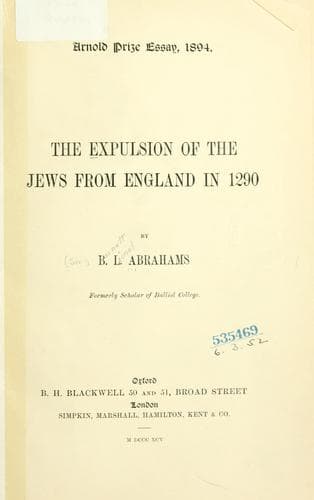
The expulsion of the Jews from England in 1290Abrahams, Barnett Lionel
History
The expulsion of the Jews from England in 1290
Abrahams, Barnett Lionel
Jews -- Great Britain -- History
The property that the Jews left behind them in England consisted of
such dwelling-houses, and other houses, as remained to them in spite of
the strict conditions imposed by the Statute of 1275, of the synagogues
and cemeteries of their local congregations, and of bonds partly for
the repayment of money, and partly for the delivery of wool and corn
for which the price had been paid in advance. All fell into the hands
of the King,[238] except, possibly, the houses in some of those towns,
such as Hereford, Winchester, and Ipswich, of which the citizens had
by the purchase of manorial rights become entitled to all fines and
forfeitures.[239] The annual value of the houses, as shown in the
returns made by the sheriffs, was, after allowance had been made for
the right of the Capital Lords, about £130. The value of the debts, as
shown in the register made by the officers of the Exchequer, was about
£9,100, but the amount for realisation was diminished by the King’s
resolve to take from the debtors, not the full amount for which they
were liable, and which, under the amended statute of the Jewry,[240]
could include three years’ interest, but only the bare principal that
had been originally advanced. Even this was not fully collected;
payment was, by the King’s permission, delayed, and confirmations,
made in 1315 and 1327, of the renunciation of interest, show how long
some of the debts remained outstanding. Edward III. finally gave up the
claim to all further payment.[241]
It was ordered that the houses should be sold and the proceeds devoted
to pious uses.[242] But it appears that they were nearly all given away
to the King’s friends.[243]
XII.--THE NECESSITY FOR THE EXPULSION.
The Expulsion was not the act of a cruel king. The forbearance which
marks the orders to the officers who were charged with the execution
of the decree had been shown by Edward many a time before, when he
protected Jews against claims too rigorously enforced, and ordered that
his own rights should be waived where insistence on them would have
deprived his debtors of their means of subsistence.[244]
Nor was it prompted by greed. It is true that immediately after it,
and according to the account of many chroniclers, as an expression of
gratitude for it, the Parliament voted a tenth and a fifteenth.[245]
But this cannot have been a bribe offered beforehand, for the writs
announcing the decree were issued on the fourth day after that for
which the Parliament was summoned.[246] It is impossible to suppose
that in so short an interval the question was brought up, the policy
chosen, the price fixed, and the decree issued. It is equally
impossible that Edward’s conduct should have been affected by the
prospect of the confiscation of the small amount of property that the
Jews left behind them.
Public-domain text, read in full here on John Shaqi.
Reviews
Reviews
No reviews yet
Be the first to share your thoughts on this work.
Join the Discussion
Join the discussion
Sign in to leave a comment or review.
Sign InorCreate an account