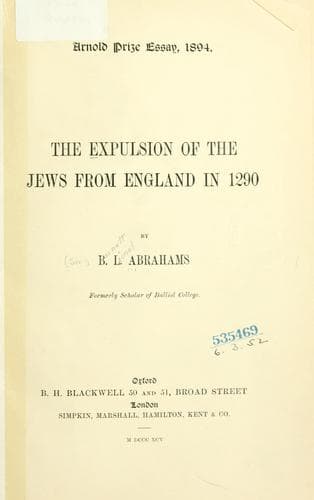
The expulsion of the Jews from England in 1290Abrahams, Barnett Lionel
History
The expulsion of the Jews from England in 1290
Abrahams, Barnett Lionel
Jews -- Great Britain -- History
The Expulsion was a piece of independent royal action, made necessary
by the impossibility of carrying out the only alternative policy
that an honourable Christian king could adopt. And the impossibility
was not of Edward’s making. It was the result of many causes, and
the knowledge of it had been brought home to him by many proofs. The
guesses of our contemporary, and all but contemporary, authorities
who take on themselves to explain his action, show how many were the
obstacles before which he had to confess himself vanquished. In one
chronicle the Expulsion is represented as a concession to the prayer
of the Pope;[247] in another, as the result of the efforts of Queen
Eleanor;[248] in a third, as a measure of summary punishment against
the blasphemy of the Jews, taken to give satisfaction to the English
clergy;[249] in a fourth as an answer to the complaints made by
the magnates of the continued prevalence of usury;[250] in a fifth
as an act of conformity to public opinion;[251] in a sixth, as a
reform suggested by the King’s independent general enquiry into the
administration of the kingdom during his absence, and his discovery,
through the complaints of the Council, of the “deceits” of the
Jews.[252]
Each of these statements gives us some information as to the nature
and extent of the failure of Edward’s policy. None gives the true
cause, for none sets before us the true position of the Jews and their
relations with their neighbours. It is true that it was the bull of
Honorius that finally compelled Edward to give up his attempt to
assimilate the position of the Jews to that of Christian traders. It
is true, no doubt, that his mother had from the first dissuaded him
from generous treatment, and, perhaps, had induced him to lessen the
chance of the success of his policy by asserting his right over them
as over his serfs.[253] But the bull of the Pope and the personal
influence of the Queen-mother were alike unnecessary. If Edward had
waived all his rights, if the Church had in his reign relented towards
the Jews instead of increasing its bitterness towards them, both acts
of generosity would have come too late. The same causes that had
made the Jews accept the position of royal usurers at the end of the
eleventh century, and of royal chattels at the end of the twelfth,
made it impossible for them to give up either position at the end of
the thirteenth. From the moment of their arrival in England they had
been hated by the common people. They never had an opportunity of
acquiring interests in common with their neighbours, or of entering
their social or industrial institutions. Isolation brought with it
danger. For the sake of safety they had to accept royal protection;
and their protectors long held them in a close grip, until one at last
refused to tolerate them under the same conditions as had satisfied his
predecessors. But to have given them their freedom would only have
been to expose them to the old dislike and the old danger.
Public-domain text, read in full here on John Shaqi.
Reviews
Reviews
No reviews yet
Be the first to share your thoughts on this work.
Join the Discussion
Join the discussion
Sign in to leave a comment or review.
Sign InorCreate an account