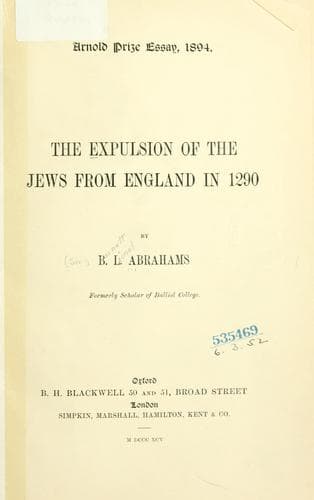
The expulsion of the Jews from England in 1290Abrahams, Barnett Lionel
History
The expulsion of the Jews from England in 1290
Abrahams, Barnett Lionel
Jews -- Great Britain -- History
Bishops supported with eagerness the charge of child-murder repeatedly
brought against the Jews,[264] though Popes and Councils had declared
it to be groundless[265]; and the judge who showed the greatest
eagerness for the punishment of the Jewish prisoners who were accused
on the monstrous charge of having murdered Hugh of Lincoln, was a man
who was held in especial honour by his contemporaries as a scholar and
“a circumspect and discreet man.”[266]
Thus the Christians were not likely to endure the Jews as neighbours
and fellow-workers, and the Jews, even if they had been permitted,
would have been as little willing to live the life and follow the
ordinary pursuits of citizens. It was not that they loved usury as
a calling. On the contrary, they entered willingly into all those
professions that gave them the opportunity of being their own
masters and living according to their own fashion. Many of them were
physicians, and among the most esteemed in Europe.[267] In Italy,
where the municipal and gild organisations were easier to enter,
and less narrow and exacting in their constitution, than those of
England,[268] they worked at trades.[269] In Sicily, under Frederic
II., some Jews were employed as administrators, and many more were
agriculturists.[270] In Rome, one was treasurer of the household of
Pope Alexander III., and in Southern France another filled the same
office under Count Raymond, of Toulouse.[271] In Austria, they were
the financial ministers of the Archduke,[272] and in Spain, one was
chamberlain to Alphonso the Wise, and many others were in the service
of the same king.[273] In England, some Jews were attached to the Court
of Henry III., and treated with special favour; others were useful and
valued adherents of Richard, King of the Romans,[274] and, after the
prohibition of usury, others, as we have seen, became corn-merchants,
and wool-merchants.
But the whole character of the Jews, their religious beliefs, and
their national hopes, were such as to make repellent to them those
close relations with Christians and Englishmen which would have
been necessary if they had entered into the feudal or municipal
organisations of the Middle Ages. Though there was no religious
obstacle to prevent them from entering a Gild, still they could not,
without violating their religion, eat at a Gild feast, or take part in
its religious ceremonies. Their teachers, like those of the Church,
warned them against social intercourse with the Christians, “lest it
might lead to inter-marriage.”[275] They did not speak the English
language.[276] They remained willingly outside the national and
municipal life.
Public-domain text, read in full here on John Shaqi.
Reviews
Reviews
No reviews yet
Be the first to share your thoughts on this work.
Join the Discussion
Join the discussion
Sign in to leave a comment or review.
Sign InorCreate an account