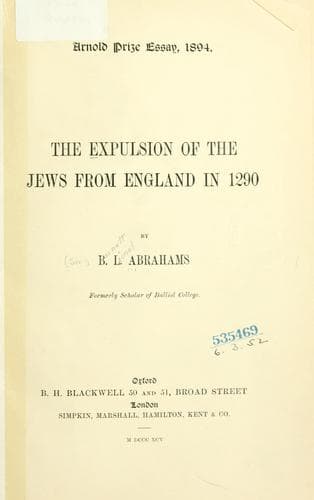
The expulsion of the Jews from England in 1290Abrahams, Barnett Lionel
History
The expulsion of the Jews from England in 1290
Abrahams, Barnett Lionel
Jews -- Great Britain -- History
Their isolation caused them no sorrow. Rather must it have been dear
to them as a sign that they were faithful members of the one race to
which in truth they belonged, the race of Israel. The interests that
filled their mind were those that were common to them, not with the
inhabitants of the country in which they lived, but with their brethren
in faith and race scattered throughout the world. The rapidity and
copiousness with which the stream of Jewish literature poured forth in
the Middle Ages, showed how unfailing was the strength of the Jewish
life which was its source. In Southern Europe the Jews waged among
themselves fierce controversies over problems such as were suggested by
the support that some of their Rabbis gave, or appeared to give, to the
Aristotelian doctrines of the eternity of matter and the uncreativeness
of God.[277] Among the English Jews, and in the communities of Northern
France with whom the English Jews were in continual communication,
literature, though less controversial and engaged with less deep
questions, sufficed, nevertheless, even better to provide continual
and engrossing interest for the orthodox. There were read and written,
down to the last years before the Expulsion, commentaries and
super-commentaries on the Bible and the Talmud, lexicons and grammars,
treatises on ritual and ceremonial. The Rabbis discussed what blessings
it was right to use on all the occasions of life, on rising in the
morning, or on retiring to rest at night, on eating, on washing, on
being married, on hearing thunder.[278] The English Jews were strict
observers of the ceremonial law,[279] they made use in daily life of
the minutiæ of Rabbinical scholarship, they drew up their contracts
“after the usage of the sages,”[280] and thus, like all the Jews of
mediæval Europe, they were continually reminded, in the pursuit of
their ordinary interests and occupations, that they were a peculiar
people. How proud they were of the position is shown by the poetical
literature which, as preserved in the Jewish prayer book, is the most
precious legacy that mediæval Judaism has left us. It was common to
Jews in all lands; it commemorated all the sorrows of their nation, and
gave expression to all their hopes. It made them feel that, scattered
as they were, they yet had a destiny of their own, and it banished from
their minds, as a counsel of baseness, the thought of making themselves
one with the “Gentiles” around them. It reminded them that exile and
persecution, and ultimate triumph were the appointed lot of Israel, and
that the same teachers who had prophesied that the Chosen People should
suffer, had also prophesied that in the fulness of time they should be
redeemed. They knew that in the hour of danger and persecution there
had never been wanting martyrs to testify in death to the unity of God
and to the Glory of his Name. And they could not doubt that the Lord
of Mercy and Justice would mete out due recompense to the oppressors
Public-domain text, read in full here on John Shaqi.
Reviews
Reviews
No reviews yet
Be the first to share your thoughts on this work.
Join the Discussion
Join the discussion
Sign in to leave a comment or review.
Sign InorCreate an account