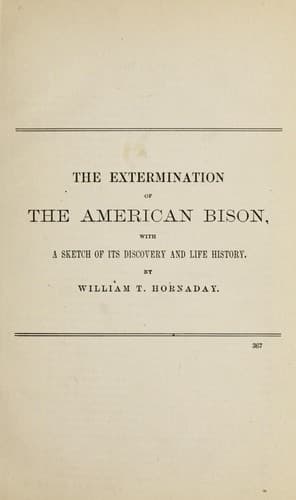
The Extermination of the American BisonHornaday, William T. (William Temple)
History
The Extermination of the American Bison
Hornaday, William T. (William Temple)
American bison; Wildlife conservation -- United States -- Sources
"(1) We want an animal that is hardy.
"(2) We want an animal with nerve and endurance.
"(3) We want an animal that faces the blizzards and endures the storms.
"(4) We want an animal that will rustle the prairies, and not yield to
discouragement.
"(5) We want an animal that will fill the above bill, and make good
beef and plenty of it.
[Illustration: HALF-BREED (BUFFALO-DOMESTIC) COW.--HERD OF C. J. JONES,
GARDEN CITY, KANSAS. Drawn by Ernest E. Thompson.]
"All the points above could easily be found in the buffalo, excepting
the fifth, and even that is more than filled as to the quality, but not
in quantity. Where is the 'old timer' who has not had a cut from the
hump or sirloin of a fat buffalo cow in the fall of the year, and where
is the one who will not make affidavit that it was the best meat he ever
ate? Yes, the fat was very rich, equal to the marrow from the bone of
domestic cattle. * * *
"The great question remained unsolved as to the quantity of meat from
the buffalo. I finally heard of a half-breed buffalo in Colorado, and
immediately set out to find it. I traveled at least 1,000 miles to find
it, and found a five-year-old half-breed cow that had been bred to
domestic bulls and had brought forth two calves--a yearling and a
sucking calf that gave promise of great results.
"The cow had never been fed, but depended altogether on the range, and
when I saw her, in the fall of 1883. I estimated her weight at 1,800
pounds. She was a brindle, and had a handsome robe even in September;
she had as good hind quarters as ordinary cattle; her foreparts were
heavy and resembled the buffalo, yet not near so much of the hump. The
offspring showed but very little of the buffalo, yet they possessed a
woolly coat, which showed clearly that they were more than domestic
cattle. * * *
"What we can rely on by having one-fourth, one-half, and three-fourths
breeds might be analyzed as follows:
"We can depend upon a race of cattle unequaled in the world for
hardiness and durability; a good meat-bearing animal; the best and only
fur-bearing animal of the bovine race; the animal always found in a
storm where it is overtaken by it; a race of cattle so clannish as never
to separate and go astray; the animal that can always have free range,
as they exist where no other animal can live; the animal that can water
every third day and keep fat, ranging from 20 to 30 miles from water; in
fact, they are the perfect animal for the plains of North America.
One-fourth breeds for Texas, one-half breeds for Colorado and Kansas,
and three-fourths breeds for more northern country, is what will soon be
sought after more than any living animal. Then we will never be
confronted with dead carcarsses from starvation, exhaustion, and lack of
nerve, as in years gone by."
Public-domain text, read in full here on John Shaqi.
Reviews
Reviews
No reviews yet
Be the first to share your thoughts on this work.
Elsewhere in the archive
Join the Discussion
Join the discussion
Sign in to leave a comment or review.
Sign InorCreate an account