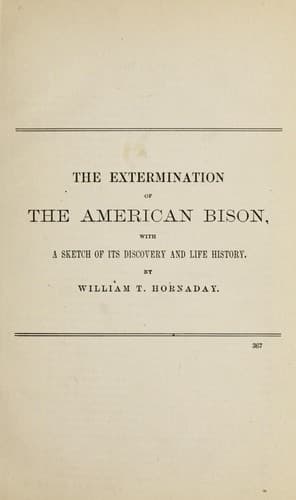
The Extermination of the American BisonHornaday, William T. (William Temple)
History
The Extermination of the American Bison
Hornaday, William T. (William Temple)
American bison; Wildlife conservation -- United States -- Sources
So long as the buffalo remained in large herds their numbers gave each
individual a feeling of dependence upon his fellows and of general
security from harm, even in the presence of strange phenomena which he
could not understand. When he heard a loud report and saw a little cloud
of white smoke rising from a gully, a clump of sage-brash, or the top of
a ridge, 200 yards away, he wondered what it meant, and held himself in
readiness to follow his leader in case she should run away. But when the
leader of the herd, usually the oldest cow, fell bleeding upon the
ground, and no other buffalo promptly assumed the leadership of the
herd, instead of acting independently and fleeing from the alarm, he
merely did as he saw the others do, and waited his turn to be shot.
Latterly, however, when the herds were totally broken up, when the few
survivors were scattered in every direction, and it became a case of
every buffalo for himself, they became wild and wary, ever ready to
start off at the slightest alarm, and run indefinitely. Had they shown
the same wariness seventeen years ago that the survivors have manifested
during the last three or four years, there would now be a hundred
thousand head alive instead of only about three hundred in a wild and
unprotected state.
Notwithstanding the merciless war that had been waged against the
buffalo for over a century by both whites and Indians, and the steady
decrease of its numbers, as well as its range, there were several
million head on foot, not only up to the completion of the Union Pacific
Railway, but as late as the year 1870. Up to that time the killing done
by white men had been chiefly for the sake of meat, the demand for robes
was moderate, and the Indians took annually less than one hundred
thousand for trading. Although half a million buffaloes were killed by
Indians, half-breeds, and whites, the natural increase was so very
considerable as to make it seem that the evil day of extermination was
yet far distant.
But by a coincidence which was fatal to the buffalo, with the building
of three lines of railway through the most populous buffalo country
there came a demand for robes and hides, backed up by an unlimited
supply of new and marvellously accurate breech-loading rifles and fixed
ammunition. And then followed a wild rush of hunters to the buffalo
country, eager to destroy as many head as possible in the shortest time.
For those greedy ones the chase on horseback was "too slow" and too
unfruitful. That was a retail method of killing, whereas they wanted to
kill by wholesale. From their point of view, the still-hunt or "sneak"
hunt was the method _par excellence_. If they could have obtained
Gatling guns with which to mow down a whole herd at a time, beyond a
doubt they would have gladly used them.
Public-domain text, read in full here on John Shaqi.
Reviews
Reviews
No reviews yet
Be the first to share your thoughts on this work.
Elsewhere in the archive
Join the Discussion
Join the discussion
Sign in to leave a comment or review.
Sign InorCreate an account