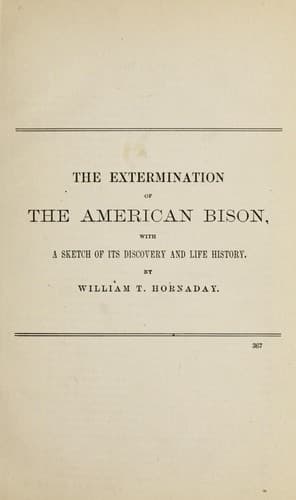
The Extermination of the American BisonHornaday, William T. (William Temple)
History
The Extermination of the American Bison
Hornaday, William T. (William Temple)
American bison; Wildlife conservation -- United States -- Sources
The following is a complete history of Congressional legislation in
regard to the protection of the buffalo from wanton slaughter and
ultimate extinction. The first step taken in behalf of this persecuted
animal was on March 13, 1871, when Mr. McCormick, of Arizona, introduced
a bill (H. R. 157), which was ordered to be printed. Nothing further was
done with it. It read as follows:
_Be it enacted, etc._, That, excepting for the purpose of using the meat
for food or preserving the akin, it shall be unlawful for any person to
kill the bison, or buffalo, found anywhere upon the public lands of the
United States; and for the violation of this law the offender shall,
upon conviction before any court of competent jurisdiction, be liable to
a fine of $100 for each animal killed, one-half of which sum shall, upon
its collection, be paid to the informer.
On February 14, 1872, Mr. Cole, of California, introduced in the Senate
the following resolution, which was considered by unanimous consent and
agreed to:
_Resolved_, That the Committee on Territories be directed to inquire
into the expediency of enacting a law for the protection of the buffalo,
elk, antelope, and other useful animals running wild in the Territories
of the United States against indiscriminate slaughter and extermination,
and that they report by bill or otherwise.
On February 16, 1872, Mr. Wilson, of Massachusetts, introduced a bill in
the Senate (S. 655) restricting the killing of the buffalo upon the
public lauds; which was read twice by its title and referred to the
Committee on Territories.
On April 5, 1872, Mr. B. C. McCormick, of Arizona, made a speech in the
House of Representatives, while it was in Committee of the Whole, on the
restriction of the killing of buffalo.
He mentioned a then recent number of _Harper's Weekly_, in which were
illustrations of the slaughter of buffalo, and also read a partly
historical extract in regard to the same. He related how, when he was
once snow-bound upon the Kansas Pacific Railroad, the buffalo furnished
food for himself and fellow-passengers. Then he read the bill introduced
by him March 13, 1871, and also copies of letters furnished him by Henry
Bergh, president of the American Society for the Prevention of Cruelty
to Animals, which were sent to the latter by General W. B. Hazen, Lieut.
Col. A. G. Brackett, and E. W. Wynkoop. He also read a statement by
General Hazen to the effect that he knew of a man who killed ninety-nine
buffaloes with his own hand in one day. He also spoke on the subject of
cross-breeding the buffalo with common cattle, and read an extract in
regard to it from the San Francisco _Post_.[69]
[Note 69: Congressional Globe (Appendix), second session Forty-second
Congress.]
On April 6, 1872, Mr. McCormick asked leave to have printed in the
Globe some remarks he had prepared regarding restricting the killing of
buffalo, which was granted.[70]
Public-domain text, read in full here on John Shaqi.
Reviews
Reviews
No reviews yet
Be the first to share your thoughts on this work.
Elsewhere in the archive
Join the Discussion
Join the discussion
Sign in to leave a comment or review.
Sign InorCreate an account