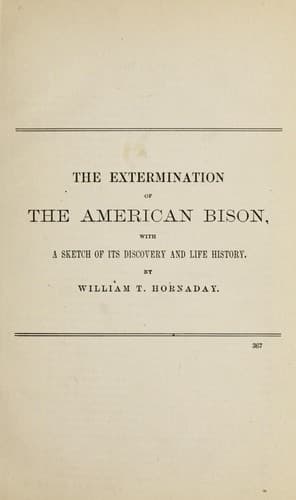
The Extermination of the American BisonHornaday, William T. (William Temple)
History
The Extermination of the American Bison
Hornaday, William T. (William Temple)
American bison; Wildlife conservation -- United States -- Sources
The opening cuts having been made, the broad-pointed "skinning-knife"
was duly sharpened, and with it the operator fell to work to detach the
skin from the body in the shortest possible time. The tail was always
skinned and left on the hide. As soon as the skin was taken off it was
spread out on a clean, smooth, and level spot of ground, and stretched
to its fullest extent, inside uppermost. On the northern range, very few
skins were "pegged out," _i. e._, stretched thoroughly and held by means
of wooden pegs driven through the edges of the skin into the earth. It
was practiced to a limited extent on the southern range during the
latter part of the great slaughter, when buffaloes were scarce and time
abundant. Ordinarily, however, there was no time for pegging, nor were
pegs available on the range to do the work with. A warm skin stretched
on the curly buffalo-grass, hair side down, sticks to the ground of
itself until it has ample time to harden. On the northern range the
skinner always cut the initials of his outfit in the thin subcutaneous
muscle which was always found adhering to the skin on each side, and
which made a permanent and very plain mark of ownership.
In the south, the traders who bought buffalo robes on the range
sometimes rigged up a rude press, with four upright posts and a huge
lever, in which robes that had been folded into a convenient size were
pressed into bales, like bales of cotton. These could be transported by
wagon much more economically than could loose robes. An illustration of
this process is given in an article by Theodore R. Davis, entitled "The
Buffalo Range," in _Harper's Magazine_ for January, 1869, Vol. xxxviii,
p. 163. The author describes the process as follows:
"As the robes are secured, the trader has them arranged in lots of ten
each, with but little regard for quality other than some care that
particularly fine robes do not go too many in one lot. These piles are
then pressed into a compact bale by means of a rudely constructed affair
composed of saplings and a chain."
On the northern range, skins were not folded until the time came to haul
them in. Then the hunter repaired to the scene of his winter's work,
with a wagon surmounted by a hay-rack (or something like it), usually
drawn by four horses. As the skins were gathered up they were folded
once, lengthwise down the middle, with the hair inside. Sometimes as
many as 100 skins were hauled at one load by four horses.
Public-domain text, read in full here on John Shaqi.
Reviews
Reviews
No reviews yet
Be the first to share your thoughts on this work.
Elsewhere in the archive
Join the Discussion
Join the discussion
Sign in to leave a comment or review.
Sign InorCreate an account