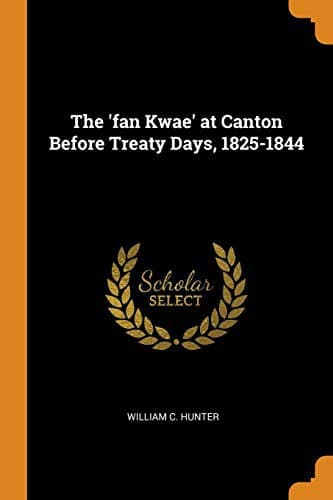
The 'Fan Kwae' at Canton Before Treaty Days 1825-1844Hunter, William C.
History
The 'Fan Kwae' at Canton Before Treaty Days 1825-1844
Hunter, William C.
Guangzhou (China) -- Commerce; Guangzhou (China) -- Description and travel
This is to give notice that should any 'superior man'
know where they are, or if they have been 'misled,' and will
inform, he shall be rewarded with _flowered red money--two great
rounds_[69] for the big one, and one great round for the little
one. Even should they have been _stolen_ (_an inconceivable
thing!_), if the person who took them will bring them to
Suy-Hong No. 2 he Shall still be rewarded, and clemency used
towards him. This placard is real; its words will not be eaten.
Taou-Kwang: 14th year, 15th day, 1st moon.
The poor dogs were never found, and the Compradore insisted upon it that
'some man hav chow-chow he,'[70] and we supposed so too.
* * * * *
On February 27, 1831, Mr. Russell and Mr. Cushing took their final leave
of Canton in the 'Bashaw' (Captain Pearson), for Boston, the former
with the satisfaction of having founded a house in that distant port
which, under his sagacious management, had secured the confidence and
consideration of the entire foreign and Chinese mercantile community, as
well as of its numerous foreign correspondents in all quarters of the
world. Its present world-wide reputation renders it needless to say that
it still exists, and has become one of the oldest, if not _the_ oldest
firm whose style has undergone no change eastward of the Cape of Good
Hope. Mr. Russell was a native of Middletown, Connecticut, a person of
singularly gentle and benevolent disposition. There was about him a
suavity and charm of manner which under no circumstances ever deserted
him. Throughout a long life he enlisted the esteem and respect of all
who knew him. Of his considerate forbearance under great provocation I
can vouch from personal experience. From my first entrance in the office
he was desirous that I should make myself acquainted with book-keeping.
Its mysteries he first taught me. However incorrectly the tyro
appreciated the relative bearing of successive transactions or bungled
in recording them, he was corrected with a patience and kindliness of
manner that knew no bounds, and the encouragement he thus received at
length led him to a clear idea of the respective value of debit and
credit, as well as to the knowledge that they were 'the two factors
which formed the base of all mercantile transactions.'
Public-domain text, read in full here on John Shaqi.
Reviews
Reviews
No reviews yet
Be the first to share your thoughts on this work.
Elsewhere in the archive
Join the Discussion
Join the discussion
Sign in to leave a comment or review.
Sign InorCreate an account