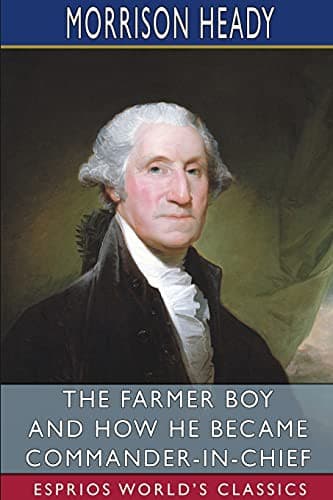
The Farmer Boy, and How He Became Commander-In-ChiefHeady, Morrison
History
The Farmer Boy, and How He Became Commander-In-Chief
Heady, Morrison
Washington, George, 1732-1799
In addition to his other cares, the duties of his office required him
to visit, from time to time, the several forts along the frontier, to
see that those already finished were kept in fighting order, and give
directions for the proper construction of those still under way. Now,
the little garrison of forty men, that Col. Dunbar had left to hold
and defend Fort Cumberland against the combined armies of the French
and Indians, was commanded by a certain Dagworthy, who, pluming
himself upon the king's commission as captain, refused to own the
authority and render obedience to the orders of Washington, who held
only a governor's commission as colonel. It will be remembered, that
Washington had a similar misunderstanding with Capt. Mackay, eighteen
months before, at the Great Meadows, touching this same question of
rank between royal and provincial officers, which had caused him great
trouble and annoyance. Matters had now come to such a pass, that a
little upstart captain of forty men could set at naught the authority
of the commander-in-chief of the forces of a whole province, merely
because he could boast a bit of paper embellished with the king's
name. This was a degradation too grievous to be longer borne by a
manly, independent spirit. Though sorely vexed and annoyed, Washington
had too much self-respect and prudence to make a noise about the
matter; but he inwardly resolved, that, as soon as the coming-on of
winter would oblige the Indians to recross the mountains to the
shelter of their homes beyond, he would take advantage of the
breathing spell thus allowed him to make a journey to Boston, there to
submit the question for final settlement to Gen. Shirley, who had
succeeded Braddock to the chief command of all the British forces in
America.
Accordingly, when the departure of the Indians brought the distressed
inhabitants of the border the prospect of a few months' peace and
quiet, he departed for Boston, in company with two of his
brother-officers, Capts. Stewart and Mercer.
Now, in those days, a journey from the Old Dominion to the Bay City, a
distance of but five hundred miles, in the depth of winter, when the
roads were either deep and stiff with mire, or rough and knobby with
frost, was really a greater undertaking than a voyage in a steamship
from Boston to Constantinople would now be considered. Our young men
travelled on horseback, as was the fashion of the day; and took with
them their negro servants, who, riding behind with their masters'
saddle-bags and portmanteaus, and dressed in fine livery, with gold
lace on their fur hats, and blue cloaks, gave quite an air of style
and consequence to the little cavalcade.
Public-domain text, read in full here on John Shaqi.
Reviews
Reviews
No reviews yet
Be the first to share your thoughts on this work.
Elsewhere in the archive
Join the Discussion
Join the discussion
Sign in to leave a comment or review.
Sign InorCreate an account