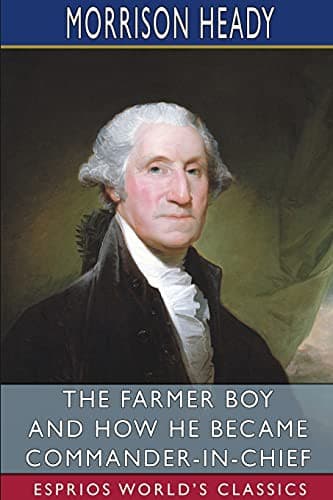
The Farmer Boy, and How He Became Commander-In-ChiefHeady, Morrison
History
The Farmer Boy, and How He Became Commander-In-Chief
Heady, Morrison
Washington, George, 1732-1799
"One day," said he, "as we were traversing a part of the
frontier, we came upon a small log-house, standing in the
centre of a little clearing, surrounded by woods on all sides.
As we approached, we heard the report of a gun,--the usual
signal of coming horror. Our party crept cautiously through the
underwood, until we had approached near enough to see what we
had already foreboded. A smoke was slowly making its way
through the roof of the house; when, at the same time, a party
of Indians came forth, laden with plunder,--consisting of
clothes, household furniture, domestic utensils, and dripping
scalps. We fired, and killed all but one, who tried to get
away, but was soon overtaken and shot down. Upon entering the
hut, there met us a sight, which, though we were familiar with
scenes of blood and massacre, struck us--at least myself--with
feelings more mournful than I had ever experienced before. On a
bed, in one corner of the room, lay the body of a young woman,
swimming in blood, with a gash in the forehead that almost
separated the head into two parts. On her breast lay two little
babes, less than a twelvemonth old, also with their heads cut
open; their innocent blood, that had once flowed in one common
vein, now mingling in the same current again. I was inured to
scenes of bloodshed and misery; but this cut me to the heart;
and never in my after-life did I raise my arm against a savage,
without calling to mind the mother and her little twins with
their heads cleft asunder. On examining the tracks of the
Indians to see what other murders they might have committed, we
found a little boy, and, a few steps forward, his father, both
scalped, and both stone-dead. From the prints of the boy's
feet, it seemed that he had been following the plough with his
father, whom he had probably seen shot down; and, in attempting
to escape, had been pursued, overtaken, and murdered. The ruin
was complete: not one of the family had been spared. Such was
the character of this miserable warfare. The wretched people of
the frontier never went to rest without bidding each other
farewell; for the chances were they might never wake again, or
wake only to find their last sleep. When leaving one spot for
the purpose of giving protection to another point of exposure,
the scene was often such as I shall never forget. The women and
children would cling around our knees, and mothers would hold
up their little babes before our eyes, begging us to stay and
protect them, and, for God's sake, not leave them to be
butchered by the savages. A hundred times, I declare to Heaven,
I would have laid down my life with pleasure under the tomahawk
and scalping-knife, could I, by the sacrifice, have insured the
safety of these suffering people."
Public-domain text, read in full here on John Shaqi.
Reviews
Reviews
No reviews yet
Be the first to share your thoughts on this work.
Elsewhere in the archive
Join the Discussion
Join the discussion
Sign in to leave a comment or review.
Sign InorCreate an account