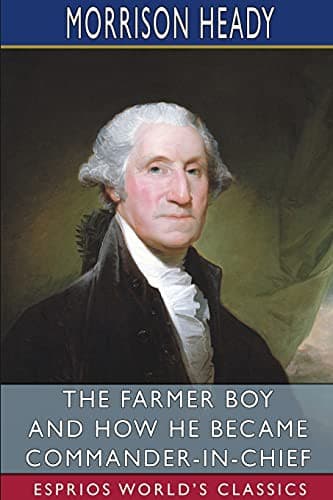
The Farmer Boy, and How He Became Commander-In-ChiefHeady, Morrison
History
The Farmer Boy, and How He Became Commander-In-Chief
Heady, Morrison
Washington, George, 1732-1799
Of this bold and skilful sailor, the most renowned that ever lived, I
should like to tell you many things; but, as we set out to give our
chief attention to the story of Washington, we must deny ourselves
this pleasure until the holidays of some merry Christmas yet to come,
when your Uncle Juvinell, if he still keeps his memory fresh and
green, will relate to you many wonderful things in the life of this
great voyager, Columbus.
Up to this time, all the nations of Christendom had for ages upon ages
been sunk in a lazy doze of ignorance and superstition. But, when
tidings of the great discovery reached their drowsy ears, they were
roused in a marvellous manner; and many of the richest and most
powerful forthwith determined to secure, each to itself, a portion of
the new-found region, by planting colonies; or, in other words, by
making settlements therein.
For this purpose, they sent out fleets of ships across the Atlantic to
these distant shores, laden with multitudes of men, who brought with
them all manner of tools and implements wherewith to clear away the
forests, till the soil, and build forts and cities, and arms to defend
themselves against the attacks of the war-like savages. Thus, for
example, Spain colonized Mexico; France, Canada; and England, that
strip of the North-American continent, lying between the Alleghany
Mountains and the Atlantic Ocean, now known as the eastern coast of
the United States.
At first, the new-comers were received and treated with much kindness
and hospitality by the natives: but it was not long before they
discovered that they were likely to be robbed of their homes and
hunting-grounds; when rage and jealousy took possession of their
hearts, and from that time forward they never let slip an opportunity
of doing all the mischief in their power to the hated intruders. Then
began that long train of bloody wars between the two races, which have
never ceased except with defeat or ruin of the weaker red man, and
bringing him nearer and nearer to the day when he must either forsake
his savage life, or cease to have an existence altogether.
Now, this may appear very unjust and wrong to my little friends; and,
to some extent, it really was: but, in those days, might made right;
or, in other words, the strong ruled the weak. And yet we are bound to
believe that all this, in the long-run, has worked, and is still
working, to the greatest good of the greatest number: for, had it been
otherwise, all this beautiful land, now the home of a Christian and
happy people, would have remained the dismal wilderness we have
described it; answering no good end, as far as concerns the spread of
truth and knowledge, and the cultivation of those useful arts which
make a nation prosperous in peace, and strong in war.
Public-domain text, read in full here on John Shaqi.
Reviews
Reviews
No reviews yet
Be the first to share your thoughts on this work.
Join the Discussion
Join the discussion
Sign in to leave a comment or review.
Sign InorCreate an account