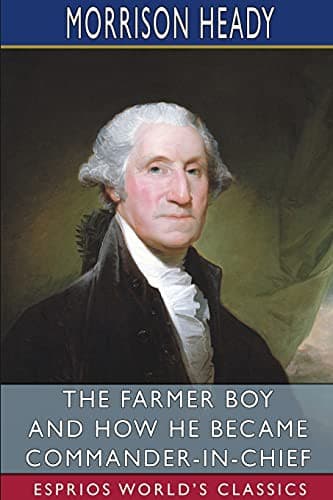
The Farmer Boy, and How He Became Commander-In-ChiefHeady, Morrison
History
The Farmer Boy, and How He Became Commander-In-Chief
Heady, Morrison
Washington, George, 1732-1799
Notwithstanding their troubles with the Indians, the hardships and
privations to which the first settlers of a wild country are always
exposed, and the shameful neglect with which they were treated by the
mother-countries, the French and English colonies went on growing and
thriving in a way that was wonderful to behold. At the end of a
hundred and fifty years, or thereabouts, they had so grown in strength
and increased in numbers, and had so widened their boundaries, that at
last the continent, vast as it is, seemed too narrow to hold them
both; and they began throwing up their elbows for more room, in a
manner that would have been thought quite uncivil in a private
individual at a dinner table or in a stage-coach.
Whereupon there arose a hot dispute between the kings of France and
England as to whom belonged all that immense region stretching from
the Alleghanies to the Mississippi, in the one direction; and, in the
other, from the Ohio to the Great Lakes of the North.
The French claimed it by the right of discovery: by which they meant,
that a certain Father Marquette had, nearly a hundred years before,
discovered the Mississippi during his wanderings as a missionary
among the Indians of the Far West. They pretended, that, as this pious
man had paddled a little canoe up and down this splendid river a few
hundred miles, his royal master, the King of France, was thereby
entitled to all the lands watered by it, and the ten thousand streams
that empty into it.
The English, on the other hand, claimed it by the right of purchase;
having, as they said, bought it at a fair price of the Six Nations, a
powerful league or union of several Indian tribes inhabiting the
region round about the great lake's Erie and Ontario. What right the
Six Nations had to it, is impossible to say. They claimed it, however,
by the doubtful right of conquest; there being a tradition among them,
that their ancestors, many generations before, had overrun the
country, and subdued its inhabitants.
Now, the poor Indians who occupied the land in question were very
indignant indeed when they heard that they and theirs had been sold to
the white strangers by their red enemies, the Six Nations, whom they
regarded as a flock of meddlesome crows, that were always dipping
their ravenous bills into matters that did not in the least concern
them; and their simple heads were sorely perplexed and puzzled, that
two great kings, dwelling in far-distant countries, thousands of miles
away beyond the mighty ocean, should, in the midst of uncounted
riches, fall to wrangling with each other over a bit of wilderness
land that neither of them had ever set eyes or foot on, and to which
they had no more right than the Grand Caliph of Bagdad, or that
terrible Tartar, Kublah Khan.
Public-domain text, read in full here on John Shaqi.
Reviews
Reviews
No reviews yet
Be the first to share your thoughts on this work.
Elsewhere in the archive
Join the Discussion
Join the discussion
Sign in to leave a comment or review.
Sign InorCreate an account