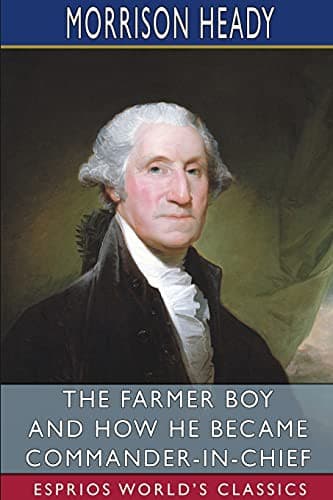
The Farmer Boy, and How He Became Commander-In-ChiefHeady, Morrison
History
The Farmer Boy, and How He Became Commander-In-Chief
Heady, Morrison
Washington, George, 1732-1799
Too well bred to seem surprised at this unbending of the haughty old
general, although he really was not a little, Washington readily, yet
with all becoming modesty, did as he was desired, in a clear, brief,
and soldierly manner. He gave it as his opinion, that their best plan
would be to divide the army into two parts,--the smaller division,
under command of Col. Dunbar, to form the rear, and bring up the heavy
guns and baggage-wagons; the larger division, under the command of
Braddock, to form the advance, and taking with it but two pieces of
light artillery, and no more baggage than could be conveniently
carried on pack-horses, push rapidly on to Fort Duquesne, and surprise
the garrison before they could receive timely warning of their danger,
or be re-enforced by the troops from Canada, which would have arrived
ere then, had not the summer drought prevented. To some extent, this
prudent advice was followed; and, to give it the force of example,
Washington reduced his baggage to a few little necessaries that he
could easily carry in a small portmanteau strapped to his back, and
gave his fine charger to be used as a pack-horse. His brother
provincial officers, accustomed as they were to dealing with the
difficulties and inconveniences of a backwoods life, in a ready,
off-hand fashion, followed his example with the greatest willingness
and good-humor. Notwithstanding this, however, there were still two
hundred pack-horses loaded with the private baggage of the English
officers, who were unwilling, even in that hour of pressing need, to
make this little sacrifice of their present comfort to the common
good. So tender did they seem of their bodily ease, and so given up to
the pleasures of appetite, that Washington began to have serious
doubts of their fitness to endure the hardships of a rough campaign,
and of their courage and firmness to face the dangers of the
battle-field.
One evening late, about this time, as the army lay encamped at the
Little Meadows, there suddenly appeared among them, from the
neighboring woods, a large party of hunters, all Pennsylvanians,
dressed in the wild garb of Indians, and armed with hatchets, knives,
and rifles. Their leader was a certain Capt. Jack, one of the greatest
hunters of his day, and nearly as famous in the border tales of
Pennsylvania as Daniel Boone in those of green Kentucky. When your
Uncle Juvinell was quite a lad, he read the story of this strange man,
in an old book, which pleased and interested him so much at the time,
that he has never since forgotten it, and will now repeat it to you in
the very words of the old chronicler:--
Public-domain text, read in full here on John Shaqi.
Reviews
Reviews
No reviews yet
Be the first to share your thoughts on this work.
Elsewhere in the archive
Join the Discussion
Join the discussion
Sign in to leave a comment or review.
Sign InorCreate an account