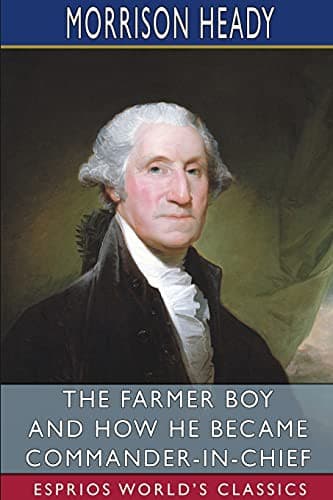
The Farmer Boy, and How He Became Commander-In-ChiefHeady, Morrison
History
The Farmer Boy, and How He Became Commander-In-Chief
Heady, Morrison
Washington, George, 1732-1799
For several days, Washington had been suffering much from fever,
attended with a racking headache, which had obliged him to travel in a
covered wagon. By the time they reached the great crossings of the
Youghiogeny, his illness had so increased, that Dr. Craik, his good
friend and physician, declared it would be almost certain death for
him to travel further; at the same time advising him to stay where he
was until his fever should somewhat abate its violence, when he could
come up with Dunbar's rear division. His brother officers also, and
even his old general, kindly urged him to give up all thought of going
on for the present; while, to render his disappointment more bearable,
some of them promised to keep him informed, by writing, of every thing
noteworthy which should happen in the course of their march. Seeing
then; was no help for it, he suffered himself to be left behind: but
it was with a sad and heavy heart that, he saw them pass on without
him; and when they had vanished, one by one, in the shadows of the
neighboring wilds, and the gleaming of their arms could no longer be
seen through the openings of the trees and bushes, he turned with a
sigh, and said to the men whom Braddock had left to nurse and guard
him, "I would not for five hundred pounds miss being at the taking of
Fort Duquesne." Here he lay for ten days; his fever, no doubt, much
aggravated by his impatience to rejoin his comrades, and the fear lest
he should not be well in time to share with them the dangers and
honors of the coming contest.
Meanwhile, Braddock pursued his slow and tedious march, and in a few
days had passed the Great Meadows, where young Washington, the year
before, as you must well remember, had learned his first lessons in
the rude art of war. A few miles beyond this, he came to a deserted
Indian camp, on the top of a rocky hill, where, to judge from the
number of wigwams, at least one hundred and seventy warriors must have
lodged. The fires were still burning; which showed but too plainly
that the stealthy foe was on the watch, and not far distant. Some of
the trees hard by had been stripped of their bark; and on their white,
sappy trunks were to be seen, in the rude picture-writing of the
Indians, savage taunts and threats of vengeance meant for the English;
while intermixed with these were bullying boasts and blackguard slang,
written in the French language, as if to force on the notice of those
who were to read them the fact, that there were white as well as red
men lurking near.
It had almost slipped my mind to tell you, that Braddock, moved
perhaps by the advice of Washington, had, before setting out from Fort
Cumberland, employed a small party of Indians, with their sachem Yadi
at their head, to serve as guides and spies during the campaign. A few
days after passing the deserted camp on the rock, four or five
soldiers, straggling too far in the rear, were suddenly waylaid by the
prowling foe, and all murdered and scalped on the spot.
Public-domain text, read in full here on John Shaqi.
Reviews
Reviews
No reviews yet
Be the first to share your thoughts on this work.
Elsewhere in the archive
Join the Discussion
Join the discussion
Sign in to leave a comment or review.
Sign InorCreate an account