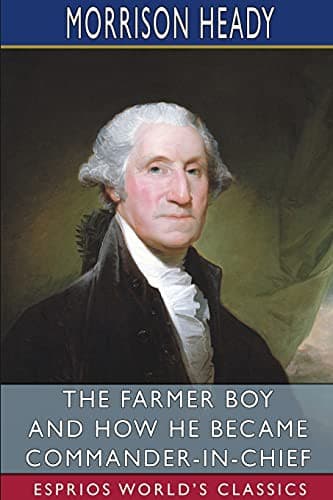
The Farmer Boy, and How He Became Commander-In-ChiefHeady, Morrison
History
The Farmer Boy, and How He Became Commander-In-Chief
Heady, Morrison
Washington, George, 1732-1799
Now, the fort and the camp lay on the same side of the river; and the
most direct route between them was by a narrow mountain pass, rising
abruptly from the water's edge on the left, and, on the right, shut
in by a steep and lofty hill, whose stony sides were overgrown with
laurel and stunted cedars and pines. As it was altogether out of the
question to drag their wagons and artillery along this pass, it was
resolved to cross the river, first at a point just over against the
camp, and then, moving down along the opposite bank, recross it at
another point five miles below; at both of which places the fords were
shallow, and the banks not high.
At last, the 9th of July, 1755,--a day ever to be remembered in
American annals,--began to dawn. Long before its first red light had
streaked the east, a hum in the camp told that the little army was,
even at that hour, all astir, and big with the bustle of preparation.
Officers and men were in the highest hopes, and looked forward with
confidence to the coming evening, when they were to plant their
victorious banners on the ramparts of Fort Duquesne. Although they had
marched thus far without serious molestation, yet Col. Washington's
fears of an ambuscade were not a whit diminished; for he felt quite
certain that they should never reach the French fort without an
attempt being made to surprise, or drive them back. Full of these
apprehensions, he went to Gen. Braddock, and, pointing out to him the
danger hanging over them, urged him by all means to send out the
Virginia rangers to scour the woods and thickets, front and flank, and
beat up the enemy, should any chance to be lurking near with the
design of drawing them into an ambuscade. No advice, as it afterwards
turned out, could have been more timely: but, coming from a raw
provincial colonel, Braddock cast it aside with angry impatience; and
when the line of march was formed, as if to show in what light esteem
he held it, he ordered the rangers to the rear, to guard the baggage.
Before daybreak, a large party of pioneers, or road-cutters, with a
small guard of regulars, numbering in all about three hundred, had
gone on before to open a passage for the army through the woods, and
make the fords more passable by levelling the banks.
Public-domain text, read in full here on John Shaqi.
Reviews
Reviews
No reviews yet
Be the first to share your thoughts on this work.
Elsewhere in the archive
Join the Discussion
Join the discussion
Sign in to leave a comment or review.
Sign InorCreate an account