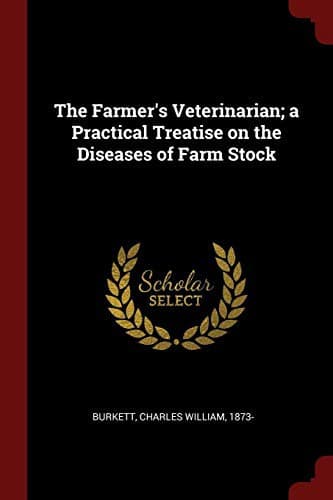
The Farmer's Veterinarian: A Practical Treatise on the Diseases of Farm StockBurkett, Charles William
Science
The Farmer's Veterinarian: A Practical Treatise on the Diseases of Farm Stock
Burkett, Charles William
Veterinary medicine
After the animal is on the road to recovery, stop the use of these
medicines and give a tonic consisting of nitrate of potash or saltpeter
and ground gentian root, half and half. Give a teaspoonful three times a
day. While the animal is sick, a little boiled flaxseed mixed with a
soft food will keep the bowels regular. It is not wise to give
purgatives, hence it is wise to give an injection consisting of warm
soapy water, so as to empty the bowels. From two to four weeks of rest
and care should be allowed for complete recovery.
=INFLUENZA.=--A specific disease of the horse affecting the mucous
membrane of the air passages. When the mucous membrane of the eyelids is
affected, pink eye results. Sometimes the mucous membrane of the
intestines is affected, in which case colic or inflammation of the
bowels results. The common cause is exposure to cold. If no work be
required, plenty of fresh air be supplied, no drafts admitted and
careful nursing otherwise, the disease will run its course in from two
to three weeks and no medicines will be necessary. In cases where
considerable cough prevails, the custom of putting a piece of camphor
about the size of an egg in a pail of boiling water and holding the
horse’s head over it from a quarter to a half hour at a time is to be
commended. The bowels should be kept free and open. Any of the ordinary
purgatives will do. If weakness occurs, give 4 tablespoonfuls each of
tincture of ginger, ground gentian root and sweet spirits of niter in a
half pint of water three times a day. Two tablespoonfuls of nitrate of
potassium given once or twice each day in the drinking water is also
desirable. As the trouble abates, the medicines suggested before may be
dropped and in their place a teaspoonful of sulphate of iron and a
tablespoonful of ground gentian root may be given daily in a bran mash
or oatmeal gruel.
=INTESTINAL WORMS IN HORSES.=--Intestinal worms may be classed as large
and small. The large worms inhabit the small intestines, and the small
ones the large intestines, the larger class of worms being more readily
reached by worm destroyers than are the smaller ones, as the small
intestines begin at the stomach and as remedies leave the stomach, the
worm soon receives the dose prepared for it, while if one dose has to
pass through about 60 feet of intestines before reaching the smaller
worms in the larger intestines, much of the worm remedy is lost by
mingling with the food, and diluted by mixing with the digestive fluids.
Thus what is a remedy for the large species of worms will have little
effect upon the smaller ones.
Public-domain text, read in full here on John Shaqi.
Reviews
Reviews
No reviews yet
Be the first to share your thoughts on this work.
Elsewhere in the archive
Join the Discussion
Join the discussion
Sign in to leave a comment or review.
Sign InorCreate an account