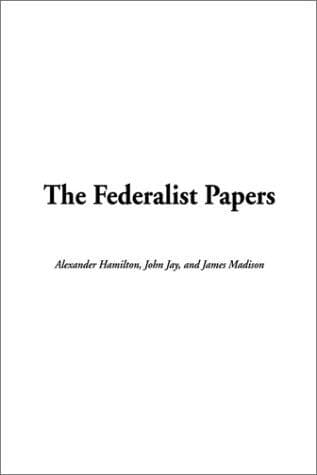
Constitutional history -- United States -- Sources; Constitutional law -- United States
If, on the contrary, the insurrection should pervade a whole State, or a
principal part of it, the employment of a different kind of force might
become unavoidable. It appears that Massachusetts found it necessary
to raise troops for repressing the disorders within that State; that
Pennsylvania, from the mere apprehension of commotions among a part of
her citizens, has thought proper to have recourse to the same measure.
Suppose the State of New York had been inclined to re-establish her lost
jurisdiction over the inhabitants of Vermont, could she have hoped for
success in such an enterprise from the efforts of the militia alone?
Would she not have been compelled to raise and to maintain a more
regular force for the execution of her design? If it must then be
admitted that the necessity of recurring to a force different from the
militia, in cases of this extraordinary nature, is applicable to the
State governments themselves, why should the possibility, that the
national government might be under a like necessity, in similar
extremities, be made an objection to its existence? Is it not surprising
that men who declare an attachment to the Union in the abstract, should
urge as an objection to the proposed Constitution what applies with
tenfold weight to the plan for which they contend; and what, as far as
it has any foundation in truth, is an inevitable consequence of civil
society upon an enlarged scale? Who would not prefer that possibility
to the unceasing agitations and frequent revolutions which are the
continual scourges of petty republics?
Let us pursue this examination in another light. Suppose, in lieu of
one general system, two, or three, or even four Confederacies were to be
formed, would not the same difficulty oppose itself to the operations of
either of these Confederacies? Would not each of them be exposed to the
same casualties; and when these happened, be obliged to have recourse to
the same expedients for upholding its authority which are objected to in
a government for all the States? Would the militia, in this supposition,
be more ready or more able to support the federal authority than in the
case of a general union? All candid and intelligent men must, upon
due consideration, acknowledge that the principle of the objection is
equally applicable to either of the two cases; and that whether we
have one government for all the States, or different governments
for different parcels of them, or even if there should be an entire
separation of the States, there might sometimes be a necessity to make
use of a force constituted differently from the militia, to preserve the
peace of the community and to maintain the just authority of the laws
against those violent invasions of them which amount to insurrections
and rebellions.
Public-domain text, read in full here on John Shaqi.
Reviews
Reviews
No reviews yet
Be the first to share your thoughts on this work.
Elsewhere in the archive
Join the Discussion
Join the discussion
Sign in to leave a comment or review.
Sign InorCreate an account