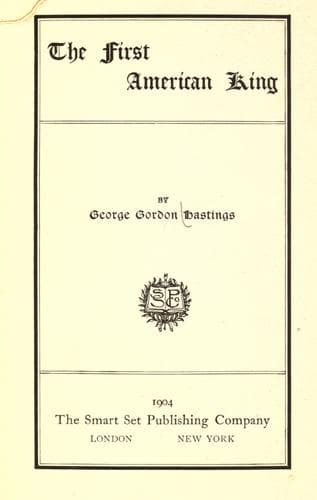
Science fiction; Speculative fiction; United States -- Politics and government -- Fiction
“Shocking, indeed!” retorted the High President. “I do not think
there is any disputing that. And do you believe that the people were
satisfied on the land question? It does not require any great depth of
learning in political economy to know that the source of all wealth is
the land. All that which we have is either taken from the earth, or
else is grown upon or fed from the surface of the earth. Is it to be
believed that God put the minerals, the oil, the coal into the earth
for the benefit of an exclusive few, or that he put them there for the
joint and common benefit of the masses of mankind? Did He make the
surface of the earth fruitful and send the showers and the sunshine,
which alone enable it to fructify, for the benefit of a chosen few,
or for the common benefit of all? That the former was the case seems
to have been the theory which prevailed under the Republic, for we
find that the great bulk of the land was owned by the comparative
few. Do you think the masses of the great cities were individually
satisfied that acre upon acre of city blocks should be owned by certain
families to whom all those dwelling in those blocks paid a heavy rent
tribute year in, year out--a tribute amounting upon an average from
one-fourth to one-third of the total income earned? What substantial
difference was there between this and mediæval feudalism? And what did
those land-cornerers do with the vast surplus sums accumulated from
the tribute wrung from those rent slaves? The chronicles show that
they cast about them for communities as yet in their incipiency but
presenting possibilities of growing into populous centres of activity.
In these growing communities, these land-gluttons bought up the best
portions of realty, which they let lie for the time being, unused
and unimproved, paying merely the low tax imposed upon unimproved
property. The community was built up by the enterprise, the labor and
the efforts of the masses; it grew into a city and became populous;
its land became valuable. When their vacant lots had acquired value
through the efforts of the people--efforts in which they had in no way
participated--these land-cornerers put up structures and proceeded with
the old game of levying the rent tribute. If ever there was an instance
of unjust enrichment, it was this.”
The Professor remained thoughtfully silent.
Public-domain text, read in full here on John Shaqi.
Reviews
Reviews
No reviews yet
Be the first to share your thoughts on this work.
Elsewhere in the archive
Join the Discussion
Join the discussion
Sign in to leave a comment or review.
Sign InorCreate an account