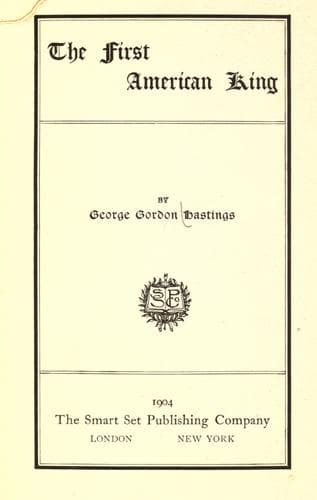
Science fiction; Speculative fiction; United States -- Politics and government -- Fiction
“Criticism--censure!” exclaimed the High President with disgust. “But
what did the people do? Did they seize upon those who withheld the food
and the warmth and rush them to public execution, as did the people of
France with their oppressing nobles in the days of the great French
Revolution? No; they did nothing! They waited and stared and suffered
like dumb cattle driven to the shambles. And the public men of the day?
They conferred a good deal and they even threatened a little, but--it
was a very respectful threatening in the face of Mighty Capital. The
Chief Magistrate of the Nation in that day was a man still young--a
man strong, vigorous and bold, who had filled various public offices
ably and well and had proved himself a brave soldier in the field. He
was the people’s idol and the people’s hope. There was food in plenty
to be had from other lands, but it was shut out from the people’s use
by an exorbitant protective tariff. Remove this tariff and food would
have flooded in upon the people in boundless store and the corner
in Monopoly and Death have been crushed out of existence in a week.
Congress held the vested right to do whatsoever might be necessary for
the welfare or safety of the people and a ringing message, couched in
his old-time, fearless form, from this Chief Magistrate would have set
the people throughout the length and breadth of the land ablaze with
enthusiasm. It would have put him beyond the power of any clique or
party, and would have exalted him to the highest pinnacle of popular
idolatry as the man of the hour, the people’s choice! His party would
not have dared to say him nay, for individually and alone he would have
stood stronger than his party. It was an opportunity such as rarely
comes to a ruler. But the voice of the cautious counselors surrounding
him in his exalted station whispered in his ear: ‘You have been accused
of being too bold, as lacking in conservatism. Do not frighten, or
attack, the great money interests--those representing the sacred and
vested Rights of Capital--lest in their fear they turn and destroy
you!’ And he hearkened to this counsel. It is true, I believe, that a
measure was finally passed temporarily admitting foreign coal free of
tariff charge, but this measure came too late. The President’s brave
heart bled for the people, but his old-time fearlessness forsook him
and he failed them. And when he so failed them, the last hope of the
Republic went out. The Republic was doomed. The shadows of Plutocracy
and of Monarchy lowered over the land!”
“And the Monarchy which came was an improvement, you consider, upon the
Republic which preceded?” asked the Professor.
“At least in this respect,” answered the High President, “that under a
monarchy we may reasonably look for class distinction, for great wealth
on the one side and for great poverty on the other, but in a true
Republic, one worthy of the name, such distinction is as unnatural as
it is iniquitous.”
Public-domain text, read in full here on John Shaqi.
Reviews
Reviews
No reviews yet
Be the first to share your thoughts on this work.
Elsewhere in the archive
Join the Discussion
Join the discussion
Sign in to leave a comment or review.
Sign InorCreate an account