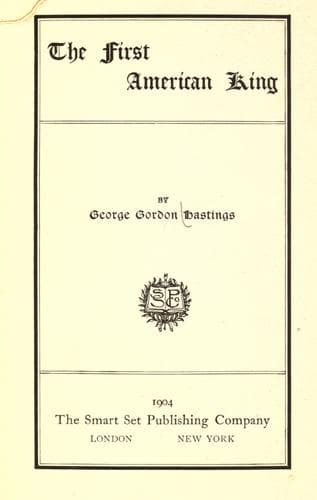
Science fiction; Speculative fiction; United States -- Politics and government -- Fiction
As for Mr. Kearns, he maintained much the same demeanor and policy
with the King that he had adopted when under the interrogatory fire of
individual members of the Court. As a result of the last visitation,
the King had found in his chamber another threatening document, which
set forth that this was the final warning; that only a few days’ grace
was accorded for his compliance with previous demands and that, failing
this, the impending doom would descend.
The King wanted to know many particulars: the disappearance of Captain
Mortimer; the wounding of Captain Swords.
Kearns adhered staunchly and steadfastly to his invariable rule never
to make partial disclosures; never to say anything until his case was
complete. There was really much to commend itself in this plan. Every
additional person to whom information was imparted, he considered,
created an additional chance of a leak; again, if by any chance one
was on the wrong track one could retrace one’s steps without letting
anyone know of the error into which one had fallen and thus lessening
confidence generally and the illusion as to one’s infallibility. But
the feature which, perhaps, weighed most of all with Mr. Kearns was
that a case told bit by bit, lost much of the dramatic sensationalism
accompanying the disclosure of the completed investigation. And Mr.
Kearns loved sensationalism and dramatic effect. He was an artist who
sought to flash up the lights suddenly upon his _mise en scène_,
and the groupings after discovery, the false scents followed up, the
wrong suspicions, the mistakes and all the precise methods employed
finally to reach the truth were so much paraphernalia of the completed
production which he desired to keep out of sight.
Following his system he had told the King practically nothing, except
that “satisfactory progress” was being made and that he would be
prepared to submit a completed case “in due course.” The wounding
of Captain Swords and the disappearance of Captain Mortimer were
incidents concerning which he would prefer not to furnish information
at the present stage. All would be duly disclosed when the case was
completed. At this the King had frowned, but Mr. Kearns was firm. The
understanding when he had taken up the matter was that he should be
permitted to employ his own methods--methods which had been tested and
had proved successful in the past--and unless he were permitted to
follow out these methods, he would not be answerable for results and
would prefer to be relieved from further prosecution of the inquiry.
As the King was intensely eager for the successful prosecution of the
inquiry, and as Kearns was a man who spoke with confidence in his
ultimate success, the King arrived at the conclusion that it was best
to permit him to pursue matters in his own peculiar way. Should his
predictions ultimately turn out a mere fiasco, the royal favor could be
withdrawn and Kearns driven forth in disgrace.
Public-domain text, read in full here on John Shaqi.
Reviews
Reviews
No reviews yet
Be the first to share your thoughts on this work.
Elsewhere in the archive
Join the Discussion
Join the discussion
Sign in to leave a comment or review.
Sign InorCreate an account