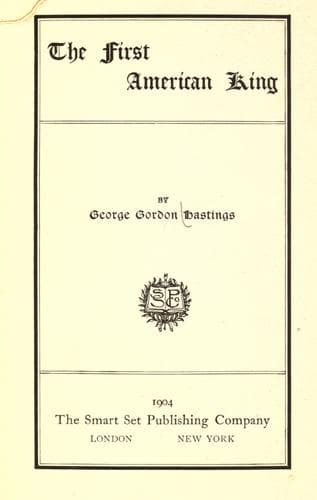
Science fiction; Speculative fiction; United States -- Politics and government -- Fiction
“You notice here,” continued Lord Ashley, pointing to an instrument
beside the wall, with a large reflector above it, “the sigmagraph. As
you know, it is used to signal the guard house to turn out a guard
of honor and salute when some visitor of rank is about to leave the
Chancellerie. Five flashes of the sigmagraph are the signal for the
guard; any smaller number are mere test signals. At sixteen o’clock,
precisely to the last stroke, you will turn your eyes to the signal
receiver upon the roof of the military quarters. Should no signal come,
you will follow out the instructions given. Should you notice three
flashes from the sigmagraph, then your orders are cancelled and the
escaping prisoner is to be permitted to pass unhindered. Are these
instructions clear to you?”
“Entirely, Milord!” answered Captain Bagley.
“And I can count upon your faithful and discreet performance?”
“Absolutely, Milord!”
“It is well, then,” said Lord Ashley. “Remember that neither His
Majesty, nor the Chancellerie, is unmindful of service and that due
reward attends those who serve His Majesty and His Majesty’s Government
faithfully and well. No better service can be done than to exterminate,
if needs be, traitors and hatchers of treason. I make myself clear to
you in this?”
“Nothing could be clearer, Milord!”
“It would not astonish me, Captain, to see you one day at the head of a
Division.”
“I shall ever strive to earn your approval, Milord Chancellor!” replied
Captain Bagley, as he saluted and retired.
While Lord Ashley was thus occupied in issuing instructions Mr. Kearns
was busily engaged in endeavoring to get in touch with the King. After
diligent inquiry, he ascertained that His Majesty had left the City
Palace and was then upon the return journey. It was, however, not His
Majesty’s intention to return direct, but to stop en route at Fairoaks,
the country estate of Sir Foxhall Sharpe, some thirty miles from the
Summer Palace, where a garden-party to be attended by the King, the
Queen and the Court was to be held that afternoon. It was rumored
in Court circles that the real attraction of the garden-party was a
certain Miss Cameron, to whom recently had been drawn the attention of
the King. The Queen, it was said, had in consequence of the presence
of this Miss Cameron among the guests been with difficulty induced to
lend her presence, only consenting finally in order to prevent the
appearance of a public scandal.
Kearns secured a phaeromobile from the royal garage and hurried off
to Fairoaks, passing as he went a number of court mobiles on the way
to the garden-party. Reaching Fairoaks, he found that the King had
arrived, but had retired to rest after his journey. His Majesty had
given orders that he was not to be disturbed.
It was only after a long and weary wait of more than two hours that
Kearns succeeded in getting his urgent message to the King. His Majesty
sent for him at once, but received him with some show of impatience.
Public-domain text, read in full here on John Shaqi.
Reviews
Reviews
No reviews yet
Be the first to share your thoughts on this work.
Elsewhere in the archive
Join the Discussion
Join the discussion
Sign in to leave a comment or review.
Sign InorCreate an account