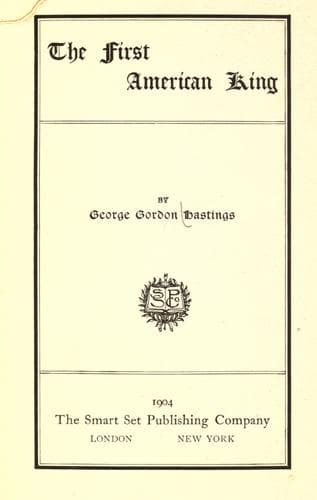
Science fiction; Speculative fiction; United States -- Politics and government -- Fiction
“Fortune favored the gallant Captain at one time and it looked as if
he might escape the dire fate of having to sell his prized liberty to
the God of Mammon, as represented in the person of an heiress. But the
luck veered and set in heavily against the bank. The right tableau
won steadily; but the left--the one nearest the banker’s heart, you
will observe--did the mischief. There came a heavy coup, both tableaux
winning, and the bank was broken.”
“Ah!” exclaimed Baroness Maquehaye with tense interest.
“The poor Captain!” remarked Lady Hadley-Barton.
“Captain Mortimer showed not the least perturbation,” resumed Countess
Brooke. “He rose from the table, lighted a cigar and, turning to those
about him, said: ‘I congratulate you, gentlemen, but that settles it
for me. Now for the Court and--the heiress!’”
“I call that an interesting story,” exclaimed Lady Hadley-Barton.
“Strange I hadn’t heard it before.”
“Interesting, perhaps, but decidedly mercenary,” commented Baroness
Maquehaye with some show of disdain.
“Mercenary!” echoed Countess Brooke, “surely you’re severe. Call it _un
mariage de convenance_--or of necessity, if you will--it sounds more
pretty! Isn’t the Captain a decidedly presentable man and one famed for
his bravery in the war? Won’t the heiress who buys him with her gold
secure her money’s worth?”
A little man--dapper and smiling--dressed in the uniform of the French
diplomatic corps, the red ribbon of the _Legion d’Honeur_ at his
buttonhole, presented himself at that moment before Dorothy. To his
profound bow and extended arm she returned a dazed stare. Her face was
strangely strained and pale. The little man was fairly taken aback.
“You promised me zis dance, you know, Mees Brandon,” he stammered. “I
am quite sure I have not made mistake as to ze numbaire. I----”
Mechanically she arose, accepted the proferred arm and went toward the
dancing-floor.
“You are not indisposed, I trust,” he inquired solicitously.
“Count D’Arville,” she exclaimed impulsively, with a pressure ever
so slight upon his gold-laced sleeve, “I know how gallant are the
gentlemen of France and that you are _le plus galant des galants_.
You’ll do me a favor, won’t you?”
The Count’s face reddened in a pleasurable flush.
“Ah, _mademoiselle_,” he exclaimed excitedly, and almost losing command
of his limited stock of English, “if I shall do you a favor? It will
give me pleasure, as you know, to lay down ze life for you. I await ze
honor of your commands.”
“Thank you, Count,” said Dorothy simply, her blue eyes flashing upon
him a grateful smile, “I knew you would. I want you to forego this
dance. You won’t mind, will you?”
A look of disappointment came into Count D’Arville’s face.
“It is a great deprivation, _mademoiselle_, but I am your slave.”
“Instead,” continued Dorothy, “you will take me to the conservatory.”
“Yes.”
“And there you’ll leave me alone--entirely alone--for a few moments,
returning for me at the end of the dance.”
Public-domain text, read in full here on John Shaqi.
Reviews
Reviews
No reviews yet
Be the first to share your thoughts on this work.
Elsewhere in the archive
Join the Discussion
Join the discussion
Sign in to leave a comment or review.
Sign InorCreate an account