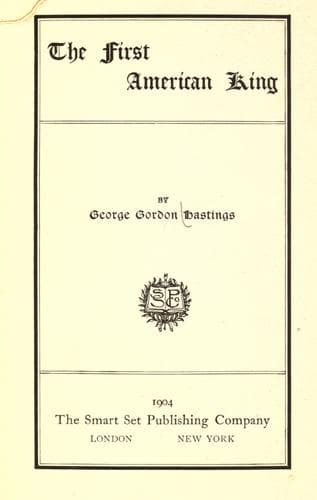
Science fiction; Speculative fiction; United States -- Politics and government -- Fiction
“Then, again, take our attitude toward drunkenness. We have recognized
that what drove men to frenzy in drink and largely promoted drunkenness
was not so much the liquor itself as the adulterations in the liquor.
Our methods of inspection of all liquors publicly sold, as also of the
public food supply, are very elaborate, and our laws on the subject of
adulteration are extremely stringent. In this respect, I am glad to
say, our people are immeasurably better off than were the people of
your day.”
“You speak in a kindly way of the people and seem to have their welfare
at heart,” ventured the Professor. “This being so, I am astonished that
you don’t reverse your policy.”
“My policy----?”
“As to the restriction of the coal supply.”
General Mainwarren started slightly.
“I must ask you to excuse me from discussing that,” he answered,
somewhat stiffly.
“Very well,” said the Professor, slightly nettled, “but there is one
other point upon which I think I have a right to receive your answer.
It is this: Under Colonel Cuming’s roof, you will remember, you
somewhat bitterly arraigned the men of my day.”
“Yes; I remember perfectly,” replied General Mainwarren. “Conceding
that the mass of people have certain rights, I claimed that the
responsibility for present conditions lies with the people of your day,
because they did not check the tendency of events in their incipiency.
Of course,” he added cautiously, “I haven’t accepted as correct your
views as to these rights. It was purely an academic discussion and I
conceded your point simply for the sake of argument.”
“I understand the point you make,” rejoined the Professor. “I was taken
somewhat unawares at the time, but the matter has been rankling in my
mind since. May I ask what were the methods which you later critics
think we might have adopted to this end?”
“My dear Professor,” protested General Mainwarren, “that’s a subject
which to treat fully would call for most extended discussion. Suffice
it to say, that in those days the people had the free exercise of the
ballot and with their votes they could have done pretty well what they
pleased.”
“Ah, you really think so!” exclaimed the Professor with some sarcasm.
“You forget our great political machines, and that they practically
controlled affairs; substantially, even if covertly, directing the
so-called will of the people!”
“I’m fully aware of that,” answered General Mainwarren, “but the man
who stands idly beneath a tree, with open mouth, awaiting the fruit
to drop, is apt to go away disappointed. What was needed was a slow,
steady, methodical education of the people, which would have placed
them upon a higher plane. With eyes fully opened to the situation,
they would have been superior to the two great political machines.
There seems to have been no steady, earnest, well-directed effort to
accomplish this--no one to undertake it!”
“How might this have been done?” questioned the Professor.
“Oh, in various ways.”
“Tell me one?”
Public-domain text, read in full here on John Shaqi.
Reviews
Reviews
No reviews yet
Be the first to share your thoughts on this work.
Elsewhere in the archive
Join the Discussion
Join the discussion
Sign in to leave a comment or review.
Sign InorCreate an account