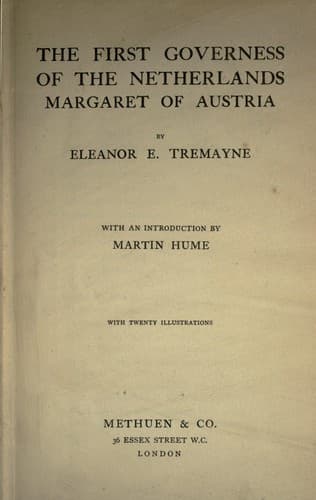
The First Governess of the Netherlands, Margaret of AustriaTremayne, Eleanor E.
History
The First Governess of the Netherlands, Margaret of Austria
Tremayne, Eleanor E.
Margaret, of Austria, Regent of the Netherlands, 1480-1530; Netherlands -- History -- Charles V, 1506-1555
'Very dear and much-loved daughter,--We have had news that on the 13th
of this month[51] (September), the French being quartered about two
leagues from Germany, near Milan, they set out and appeared before the
said town. Wherefore the Swiss who were in the town of Milan, having
quitted the flat country, being informed of this fact, left the town
about twenty thousand strong and marched against the French, and about
four o'clock in the afternoon of the same day, the Swiss and French
began to fight each other, more by way of skirmishing than giving
battle, for there were so many ditches that the French men-at-arms on
horseback could not help their foot-soldiers, and fought so long that
night surprised them; and all that night the said Swiss and French
remained on the field of battle, without attacking each other until
the morrow, the 14th of the month, when they renewed the battle, which
lasted quite three hours, after which fight about three thousand of
the said landsknechts (foot-soldiers) and as many or more Swiss were
left dead upon the field. And because there was mutiny and division
amongst the said Swiss, through some of their people making peace with
the French and refusing to fight, they retreated some to Milan and
others to Como, without either party pursuing or trying to fight the
other. And because they could not subdue the mutiny, the day after
they left the above-mentioned places and returned to their own
country....'
[51] Maximilian, writing on the 7th October, makes a mistake in
the date. The battle began on September 12th.
After the battle Maximilian Sforza, Duke of Milan, yielded his rights
to the conqueror and accepted a pension of 30,000 crowns.
Before the year was out, Francis I. and the Pope met at Bologna and
arranged a peace which was signed at Fribourg and called 'La Paix
perpétuelle.'
In the lull that followed the battle of Marignano Maximilian found
time to turn his attention to the interesting occupation of planning
marriages for his grandchildren. His Court has been called a sort of
matrimonial agency, and his letters to Margaret abound in projects and
schemes for grand alliances for his granddaughters. In the spring of
1515 he had met the Kings of Poland and Hungary at Vienna. Vladislav
II., King of Hungary, had a son Louis, whose marriage was now arranged
with Mary of Austria, whilst his daughter Anna was betrothed to
Ferdinand of Austria, Maximilian's youngest grandson. It was hoped
that this double marriage would secure the kingdom of Hungary to the
House of Hapsburg, besides carrying out the original treaty of 1463
between the Emperor Frederick III. and King Mathias.
Public-domain text, read in full here on John Shaqi.
Reviews
Reviews
No reviews yet
Be the first to share your thoughts on this work.
Elsewhere in the archive
Join the Discussion
Join the discussion
Sign in to leave a comment or review.
Sign InorCreate an account