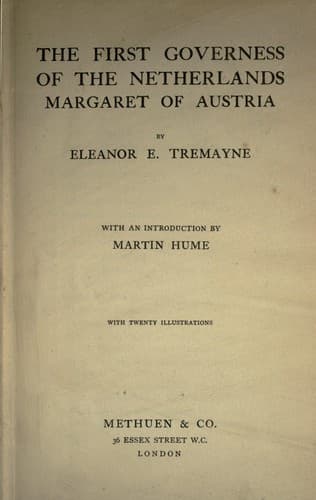
The First Governess of the Netherlands, Margaret of AustriaTremayne, Eleanor E.
History
The First Governess of the Netherlands, Margaret of Austria
Tremayne, Eleanor E.
Margaret, of Austria, Regent of the Netherlands, 1480-1530; Netherlands -- History -- Charles V, 1506-1555
Charles's arrival in Spain caused great excitement among high and low,
and every one was speculating about his appearance, character, and
accomplishments. The Bishop of Badajoz sent the following interesting,
though somewhat exaggerated, description of the new king and his
surroundings to Cardinal Ximenes: 'The prince,' he says, 'has good
parts, but he has been kept too much isolated from the world, and, in
particular, he knows too little of Spaniards. He does not understand a
single word of Spanish. He obeys his councillors implicitly; but, as
he has entered the seventeenth year of his age, it would be well if he
took part in the discussions of his Council.
'Monsieur de Chièvres is the most influential person in the prince's
Court; he is prudent and gentle, but avaricious. The same may be said
of the Chancellor of Burgundy. On the whole, love of money is the
besetting sin of the Flemings. They buy and sell the Government
offices, and it is to be feared that they will introduce the same
custom into Spain.... Monsieur de Chièvres is a Frenchman by birth,
and keeps the prince very much under subjection to the King of France.
The prince signs his letters to the King of France, "Your humble
servant and vassal,"... and though he signs himself to others
"Principe," he likes to be called king....'
Cardinal Ximenes' health was now rapidly declining. When the news of
Charles's arrival in Spain had been brought to him he revived a
little, and sent the young king letters of welcome, filled with good
advice as to the best way of securing his people's affection. Charles
answered in the most deferential manner, but his Belgian Ministers,
fearing that the Cardinal would exercise too much influence over him,
prevented their meeting by keeping the king in the north, and
estranging him from Ximenes. Through their advice Charles wrote to the
Cardinal in a very different strain, depriving him not only of the
regency but of all share in state affairs. When the letter was brought
to Ximenes at Roa he was dangerously ill. Adrian de Burgo was with
him, but feared to tell him of the royal command, and the great
Cardinal, who had preserved the kingdom of Castile intact for his
master, passed away without the knowledge of Charles's ingratitude. He
died on the 8th of November 1517 in the eighty-third year of his age.
De Chièvres had now no rival, and hoped to be as powerful in Spain as
he was in the Netherlands.
CHAPTER X
DEATH OF MAXIMILIAN
Public-domain text, read in full here on John Shaqi.
Reviews
Reviews
No reviews yet
Be the first to share your thoughts on this work.
Elsewhere in the archive
Join the Discussion
Join the discussion
Sign in to leave a comment or review.
Sign InorCreate an account