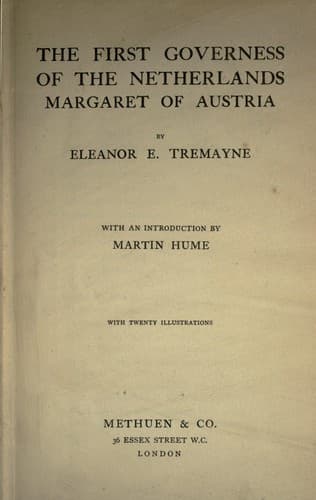
The First Governess of the Netherlands, Margaret of AustriaTremayne, Eleanor E.
History
The First Governess of the Netherlands, Margaret of Austria
Tremayne, Eleanor E.
Margaret, of Austria, Regent of the Netherlands, 1480-1530; Netherlands -- History -- Charles V, 1506-1555
Since the summer Maximilian's health had gradually been declining. In
July he presided for the last time at the Diet of Augsburg, and
earnestly pressed for the fulfilment of his two dearest wishes--the
fitting out of a crusade against the Turks, and the elector's promise
to secure the succession to the imperial crown for his grandson,
Charles. To this latter request there existed the obstacle, that as he
himself had never been crowned by the Pope, he was only regarded by
the Roman See as King of the Romans, and therefore Charles could not
be invested with that dignity. Maximilian, however, spared no means to
gain his ends, and bribed heavily wherever he thought it advisable.
Charles appears to have objected to the exorbitant price that was put
upon the imperial crown, knowing well that he would one day have to
raise the promised sums from his resources in Spain, but his
grandfather and Margaret, with their councillors, overruled his
objections, and strongly advised him not to bargain for fear of the
French king profiting by his stinginess. In an enigmatical letter
Margaret thus expresses herself:--'The Lord King, my nephew, has
written to us that the horse on which he wishes to come and see us is
very dear. We know well that it is dear; but as matters stand, if he
does not wish to have it, there is a buyer ready to take it, and,
since he has broken it in, it seems a pity that he should give it up,
whatever it costs him.'[60] Whilst Maximilian was engaged in taking
measures to obtain his desires, the elector's attention was fully
occupied by formidable religious troubles. The monk, Martin Luther,
had arisen and vehemently declaimed against certain practices of the
Church of Rome, and a spirit of revolt and restlessness was in the
air. Maximilian does not appear to have been greatly interested in the
commencement of the Reformation. Although in his letters to Margaret
he often satirically complained of 'les beaux pratikes de la sainte
mère de l'Église,' still he was far from upholding any schism in the
Church, and urged on by the solicitations of the monks, he wrote to
Leo X. asking him to determine the religious disputes by his decision,
and summoned Luther to appear with a safe conduct before the Diet of
Augsburg to answer for his attack on the system of Indulgences. Luther
arrived too late for the Assembly, and the emperor never saw him, but
at the subsequent interview that took place before the Cardinal Legate
the monk was told he must either recant his heresies or depart. He
refused to recant, and departed to Wittenberg, there to write and
publish an account of his interview, which was read far and wide, and
helped to further the spirit of schism and revolt.
[60] Gachard, _Rapport sur les Archives de l'Ancienne Chambre des
comptes de Flandre à Lille_.
Public-domain text, read in full here on John Shaqi.
Reviews
Reviews
No reviews yet
Be the first to share your thoughts on this work.
Elsewhere in the archive
Join the Discussion
Join the discussion
Sign in to leave a comment or review.
Sign InorCreate an account