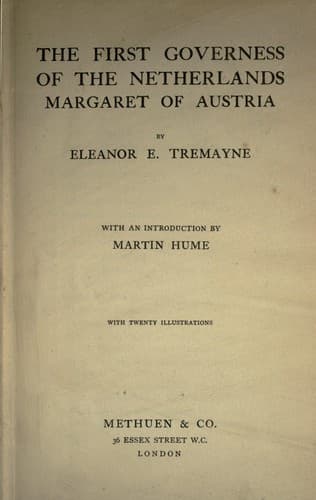
The First Governess of the Netherlands, Margaret of AustriaTremayne, Eleanor E.
History
The First Governess of the Netherlands, Margaret of Austria
Tremayne, Eleanor E.
Margaret, of Austria, Regent of the Netherlands, 1480-1530; Netherlands -- History -- Charles V, 1506-1555
Adrian VI. was an upright, conscientious, and honest man, but quite
unfitted for the high position he was called upon to fill, and his
reign of ten months was unsuccessful and unhappy. As he himself once
exclaimed, 'Let a man be never so good, how much depends upon the
times in which he is born.' A learned scholar and rigid
disciplinarian, he regarded the conduct of the reformers with horror;
but at the same time candidly acknowledged the abuses and corruptions
that disgraced both the Court and Church of Rome. This moderation,
whilst it disgusted the great ecclesiastics in Italy, tended to
encourage the reformation in Germany. A host of pamphlets and
caricatures were circulated, and helped to popularise the new ideas
and spread the reformed religion far and wide. Charles hastened to
forbid under pain of death the printing of literature directed against
the Pope or the Church of Rome, and ordered Francis Van der Hulst to
hunt all Lutherans out of the Netherlands.
On the 15th of March 1522 Margaret convoked the States-General at
Brussels. The emperor, through his Chancellor, complimented the
citizens on their loyal conduct and bravery at the recent siege of
Tournay, which had greatly helped towards its reduction. 'The French,'
he said, 'have sustained a great loss in losing Milan and Tournay,
which are of such importance, as every one knows.' His approaching
journey to Spain was then announced, and he informed them of the
treaties he had made, and the precautions taken for the defence of the
country, thanking his brave subjects for the zeal they had shown in
his service. He informed them that during his absence the government
would be confided to Margaret, 'who for so long has shown by her
praiseworthy, memorable services and great experience, that she well
knows how to honourably acquit herself of the said government and
administration. For which good rule and conduct his Majesty and you
are beholden to her through the fervent zeal and natural love she
bears you.' The Chancellor ended his long speech by saying that the
emperor hoped they would live peaceably with each other during his
absence--'for their strength lay in unity....'[80]
[80] _MSS. de la Bibliothèque de Bourgogne._
Charles, who was now preparing to visit England on his way to Spain,
was sadly in want of money. Margaret did her best to help him, and in
order to raise funds pawned her jewels to the Count of Hochstrate.
'My said Lady, obeying the order of his Majesty, has offered to leave
her rings with the said Hochstrate, until he has been acquitted and
discharged of the last sums he furnished... at the very pressing
request and insistence of my said Lady, knowing that in this lies his
Majesty's honour, but he has behaved so well that he will not keep
them.'[81]
[81] _Correspondance de Marguerite avec Charles-Quint._
Public-domain text, read in full here on John Shaqi.
Reviews
Reviews
No reviews yet
Be the first to share your thoughts on this work.
Elsewhere in the archive
Join the Discussion
Join the discussion
Sign in to leave a comment or review.
Sign InorCreate an account