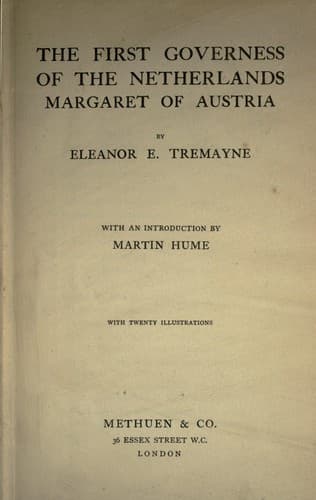
The First Governess of the Netherlands, Margaret of AustriaTremayne, Eleanor E.
History
The First Governess of the Netherlands, Margaret of Austria
Tremayne, Eleanor E.
Margaret, of Austria, Regent of the Netherlands, 1480-1530; Netherlands -- History -- Charles V, 1506-1555
Three days after the battle Francis received a visit from the chiefs
of the victorious army, who offered him their sympathy, the Marquis of
Pescara even appearing in mourning. During the interview the king
showed great fortitude, and with a show of cheerfulness discussed
various points of the battle with his capturers. The castle of
Pizzighitone was chosen for his temporary prison until instructions
were received from Spain.
The emperor was at Madrid when the messenger arrived with the news of
the victory. Charles showed extraordinary self-control, and neither by
voice nor manner gave any outward sign of exultation. As if dazed, he
repeated the words of the messenger: 'The battle is fought and the
king is your prisoner!'[96] And then, hardly permitting the
congratulations of the surrounding courtiers, he retired to his
oratory, where, falling on his knees, he spent a long interval in
prayer, after which he asked for details of his victory. Bonfires and
illuminations and all public rejoicings were strictly forbidden as
being unsuitable 'when a Christian king had fallen into such great
misfortune.' This moderation and humility called forth the admiration
of all who witnessed it. Dr. Sampson, King Henry's ambassador at the
Court of Madrid, wrote to Wolsey: '... The emperor hath used such
demeanour in all things, both by word, deed, and countenance, and
toward all manner of persons, that every wise man hath been most
joyful to see it....'[97]
[96] E. Armstrong, _The Emperor Charles V._
[97] Ellis, _Original Letters_.
On the following day Charles went in procession to the church of Our
Lady of Atocha to give thanks for the victory, the preacher, however,
being forbidden to enlarge on the triumph. But this extremely humble
attitude did not prevent Charles from making the most of his success.
On the 14th of March he sent the following letter to his
brother-in-law, the King of Portugal:--
Public-domain text, read in full here on John Shaqi.
Reviews
Reviews
No reviews yet
Be the first to share your thoughts on this work.
Elsewhere in the archive
Join the Discussion
Join the discussion
Sign in to leave a comment or review.
Sign InorCreate an account