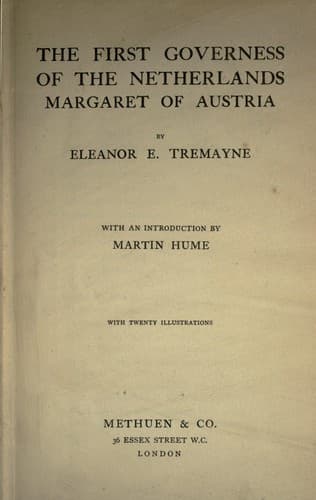
The First Governess of the Netherlands, Margaret of AustriaTremayne, Eleanor E.
History
The First Governess of the Netherlands, Margaret of Austria
Tremayne, Eleanor E.
Margaret, of Austria, Regent of the Netherlands, 1480-1530; Netherlands -- History -- Charles V, 1506-1555
Meanwhile, on the 17th of March, King Francis had been set at liberty.
Charles in a letter to his brother says: 'The King of France was
restored to his kingdom on the 17th of this month (February), on my
receiving the Dauphin and Duke of Orleans as hostages, whom I have
desired to be taken to Burgos; and the said King of France promises to
accomplish all that he has engaged in by the treaty of peace....'
Guicciardini gives the following interesting account of the exchange
of prisoners at Fuenterrabia: 'By this time the French king was come
to Fuenterrabia, a town appertaining to the emperor, standing near the
Ocean Sea upon the frontiers of Biscay and the duchy of Guyenne; and
on the other side the Lady Regent was arrived with the children of
France at Bayonne, which is not far from Fuenterrabia.... Then the
18th day of March, the French king, accompanied by the viceroy,
Captain Alarçon, with fifty horse, came to the shore of the river that
divideth the realm of France from the kingdom of Spain; at the same
time M. de Lautrech, with the king's children, and the like number of
horse, presenting themselves on the other side. There was in the midst
of the river a great barque made fast with anchors, in which was no
person. The king approached to this barque in a little boat, wherein
he was accompanied by the viceroy, etc.... all armed with short
weapons, and on the other side of the barque were likewise brought in
a little boat, M. de Lautrech, with the hostages... after this the
viceroy went into the barque... and the king with him.... M. de
Lautrech fetched out of the boat into the barque the Dauphin, who
being given to the viceroy... was forthwith bestowed in his boat, and
after him followed the little Duke of Orleans, who was no sooner
entered the barque than the French king leaped out of the barque into
his boat with such swiftness that his permutation was thought to be
done at one self instant, and then the king being brought to the
shore, mounted suddenly (as though he had feared some ambush) upon a
Turkish horse of a wonderful swiftness, which was prepared for the
purpose, and ran without stay to St. John de Luz, a town of his
obedience, four leagues from thence; and being there readily relieved
with a fresh horse, he ran with the same swiftness to Bayonne, where
he was received with incredible joy of all the Court.'[122]
[122] Published in 1618. Mentioned by W. Bradford in his
_Correspondence of the Emperor Charles V._
In a despatch to the emperor, written on March 23rd, Ochoa de Ysasaga
announced that 'The day that the King of France was released from his
captivity he leaped from the boat, with water up to his knees, mounted
a horse that had been prepared for him, and rode without stopping to
St. Jean de Luz, where he dined, and was visited by the flower of the
French nobility, who came to congratulate him.[123]
[123] _Calendar of Spanish State Papers_, vol. iii.
Public-domain text, read in full here on John Shaqi.
Reviews
Reviews
No reviews yet
Be the first to share your thoughts on this work.
Elsewhere in the archive
Join the Discussion
Join the discussion
Sign in to leave a comment or review.
Sign InorCreate an account