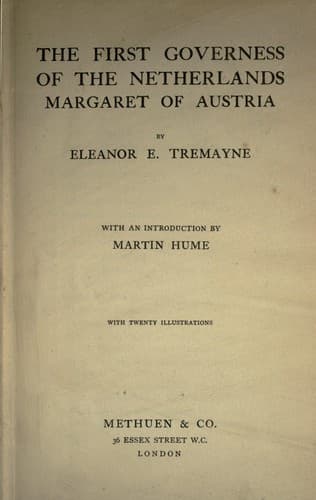
The First Governess of the Netherlands, Margaret of AustriaTremayne, Eleanor E.
History
The First Governess of the Netherlands, Margaret of Austria
Tremayne, Eleanor E.
Margaret, of Austria, Regent of the Netherlands, 1480-1530; Netherlands -- History -- Charles V, 1506-1555
Although only in her fiftieth year, Margaret began to look forward to
the time when she could hand over the government of the Netherlands to
her nephew Charles and spend the rest of her days in quiet seclusion.
For her life had been a very strenuous one, full of great
responsibility and unceasing work, and now that she felt her mission
accomplished, she longed for her nephew's advent and her own
retirement from political life. Chiefly owing to her intervention,
that peace which it had been her lifelong endeavour to promote, now
reigned throughout Europe, and under her wise rule the Netherlands had
reached the zenith of their prosperity. Art, industry, and commerce
flourished in the Low Countries as they had never flourished before.
Encouraged by Margaret, a brilliant group of artists, poets, and
literary men settled at her Court at Malines. Merchants from England,
Spain, France, and Italy attended the great fairs, and traded in arms,
embroideries, tapestries, velvets, satins, cloth, and leather goods.
Malines became noted for its various industries, and Brussels, Ypres,
Liége, Ghent, Lille, and Tournay all rose rapidly into commercial
centres. Architecture made enormous strides, and music, painting, and
literature received a new birth.
[Illustration: INTERIOR OF COURTYARD IN MARGARET'S PALACE AT
MALINES, NOW THE PALACE DE JUSTICE]
In her palace at Malines Margaret collected all that was rare and
beautiful, and her rooms were veritable museums, as the inventory
written under her direction shows. Priceless tapestries hung on the
walls, some of which she had brought from Spain, whilst others were
presented to her on various occasions. Many rich and valuable objects
are mentioned in her catalogue: Statuettes, gold and silver caskets
and mirrors, crystal, chalcedony and jasper goblets and vases, carved
ivories, amber, corals, and curiously wrought chessmen, beautiful
fans, medallions, clocks of rare workmanship which struck the hours
and half-hours, magnificent plate, sometimes inlaid with precious
stones, glass and pottery, suits of armour, ivory hunting horns, and
various relics of the chase. Her private library contained many rare
and valuable books, chiefly bound in velvet (crimson, green, black,
and blue), with gold and silver clasps, besides illuminated
manuscripts, several bearing her devices in the borders and strewn
with painted 'marguerites.' The 'Bibliothèque Royale' at Brussels
possesses several manuscripts from Margaret's collection. Amongst
others, her 'Book of Hours'; four of her albums; 'La Bible
Historiale,' with portraits of her and Philip kneeling at their
'prie-dieu'; Her 'Album Musical,' and her book of 'Basses Danses' on
black paper, with gold notes and letters, containing a set of dances
fashionable in her day--'La Marguerite,' 'l'Espérance de Bourbon,'
'M'amour-m'amie,' 'Filles à marier,' 'Le joyeux de Bruxelles,' etc. A
portrait of Margaret in water-colours is also in the library, and is
probably by Horembout.
Public-domain text, read in full here on John Shaqi.
Reviews
Reviews
No reviews yet
Be the first to share your thoughts on this work.
Elsewhere in the archive
Join the Discussion
Join the discussion
Sign in to leave a comment or review.
Sign InorCreate an account