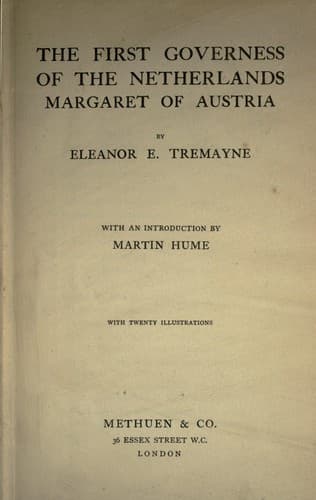
The First Governess of the Netherlands, Margaret of AustriaTremayne, Eleanor E.
History
The First Governess of the Netherlands, Margaret of Austria
Tremayne, Eleanor E.
Margaret, of Austria, Regent of the Netherlands, 1480-1530; Netherlands -- History -- Charles V, 1506-1555
The church of Brou is of the latest, and not the best, period of
Gothic architecture, but the genius of Margaret is visible in all its
details, harmonising the work, whether Gothic or Renaissance, and
creating a building of extraordinary beauty. French, Italian, and
German artists helped in building this princely monument, which
remains a fitting memorial to one of the most cultivated women of her
time.
The plan of the church is very simple. A Latin cross with five naves;
the transept and sanctuary separated by a rood screen. The length is
about 225 feet, and its greatest width, in the transept, 120 feet.
Outside, the central building is divided into three distinct stories.
The façade, with its great door decorated with devices and emblems. An
_Ecce Homo_ in the centre, on either side Philibert and Margaret
kneeling between two angels, and accompanied by their patron saints. A
statue of Saint Nicholas de Tolentin guarding the entrance.
On the second story are three pointed windows between two galleries.
Above the upper gallery is a triangular gable with a rose window in
the centre, surrounded by three triangular windows, a symbol of the
Trinity. Inside, the carved woodwork of the choir stalls is remarkable
for its beauty of detail, variety of design, and delicacy of carving.
The stalls are the work of Bressian artists, foremost amongst whom was
Pierre Terrason of Bourg. They were finished and put up in 1532. There
are seventy-four stalls on each side, in two rows--twenty-one above
and sixteen below. The design on each stall is different.
But the tombs in the choir are the most interesting features of the
church of Brou.
Jean Perréal (called Jean de Paris) had been commissioned by Margaret
to prepare the plans, and after years of work he presented her with a
design which she considered perfect, and gave orders to have it
carried out. But soon after Perréal was dismissed, and Van Boghen
presided over the work. There is little doubt that he made use of the
French architect's designs, which Margaret possessed,[148] but he
evidently made important modifications, as the work bears distinct
traces of Flemish influence. The best Belgian, French, Italian, and
Swiss workmen were employed on these monuments. The principal work was
given to a Swiss, Conrad Meyt, who undertook to make the five large
statues. The three monuments are placed in the positions Margaret
desired in her will of 1508--Duke Philibert in the centre, his mother
on the right, and her tomb on the left.
[148] Michel Colombe made a model from Perréal's plans for the
sum of ninety-four florins.
Public-domain text, read in full here on John Shaqi.
Reviews
Reviews
No reviews yet
Be the first to share your thoughts on this work.
Elsewhere in the archive
Join the Discussion
Join the discussion
Sign in to leave a comment or review.
Sign InorCreate an account