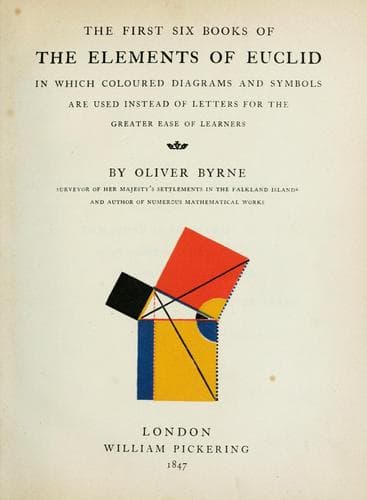
The First Six Books of the Elements of EuclidEuclid
Science
The First Six Books of the Elements of Euclid
Euclid
Euclid's Elements; Mathematics, Greek
2. If the point be above the plane, there can be but one normal; for, if there could
be two, they would be parallel [XI. vi.] to one another, which is absurd.
Therefore from the same point there can be drawn but one normal to a given
plane.
PROP. XIV.—Theorem.
Planes (CD, EF) which have a common normal (AB) are parallel to each
other.
Dem.—If the planes be not parallel, they will meet when produced. Let them
meet, their common section being the line GH, in which take any point K. Join AK,
BK. Then because AB is normal to the plane CD, it is perpendicular to the line
AK, which it meets in that plane [XI. Def. vi.]. Therefore the angle BAK is right. In
like manner the angle ABK is right. Hence the plane triangle ABK has two right
angles, which is impossible. Therefore the planes CD, EF cannot meet—that is, they
are parallel.
Exercises.
1. The angle between two planes is equal to the angle between two intersecting normals to these
planes.
2. If a line be parallel to each of two planes, the sections which any plane passing through it
makes with them are parallel.
3. If a line be parallel to each of two intersecting planes, it is parallel to their intersection.
4. If two right lines be parallel, they are parallel to the common section of any two planes
passing through them.
5. If the intersections of several planes be parallel, the normals drawn to them from any point
are coplanar.
PROP. XV.—Theorem.
Two planes (AC, DF) are parallel, if two intersecting lines (AB, BC) on one of
them be respectively parallel to two intersecting lines (DE, EF) on the
other.
Dem.—From B draw BG perpendicular to the plane DF [XI. xi.], and let it
meet that plane in G. Through G draw GH parallel to ED, and GK to EF. Now,
since GH is parallel to ED (const.), and AB to ED (hyp.), AB is parallel to GH
[XI. ix.]. Hence the sum of the angles ABG, BGH is two right angles [I. xxix]; but
BGH is right (const.); therefore ABG is right. In like manner CBG is right. Hence
BG is normal to the plane AC [XI. Def. vi.], and it is normal to DF (const.). Hence
the planes AC, DF have a common normal BG; therefore they are parallel to one
another.
PROP. XVI.—Theorem.
If two parallel planes (AB, CD) be cut by a third plane (EF, HG), their
common sections (EF, GH) with it are parallel.
Dem.—If the lines EF, GH are not parallel, they must meet at some
finite distance. Let them meet in K. Now since K is a point in the line EF,
and EF is in the plane AB, K is in the plane AB. In like manner K is
a point in the plane CD. Hence the planes AB, CD meet in K, which is
impossible, since they are parallel. Therefore the lines EF, GH must be
parallel.
Exercises.
1. Parallel planes intercept equal segments on parallel lines.
2. Parallel lines intersecting the same plane make equal angles with it.
3. A right line intersecting parallel planes makes equal angles with them.
PROP. XVII.—Theorem.
Public-domain text, read in full here on John Shaqi.
Reviews
Reviews
No reviews yet
Be the first to share your thoughts on this work.
Elsewhere in the archive
Join the Discussion
Join the discussion
Sign in to leave a comment or review.
Sign InorCreate an account