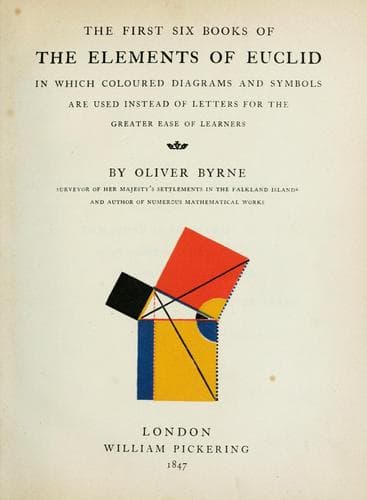
The First Six Books of the Elements of EuclidEuclid
Science
The First Six Books of the Elements of Euclid
Euclid
Euclid's Elements; Mathematics, Greek
”In the text of the propositions, the author has adhered, in all but a few instances, to the
substance of Euclid’s demonstrations, without, however, giving way to a slavish following of his
occasional verbiage and redundance. The use of letters in brackets in the enunciations eludes the
necessity of giving a second or particular enunciation, and can do no harm. Hints of other proofs are
often given in small type at the end of a proposition, and, where necessary, short explanations. The
definitions are also carefully annotated. The theory of proportion, Book V., is given in an algebraical
form. This book has always appeared to us an exquisitely subtle example of Greek mathematical
logic, but the subject can be made infinitely simpler and shorter by a little algebra, and
naturally the more difficult method has yielded place to the less. It is not studied in schools,
it is not asked for even in the Cambridge Tripos; a few years ago, it still survived in
one of the College Examinations at St. John’s, but whether the reforming spirit which
is dominant there has left it, we do not know. The book contains a very large body of
riders and independent geometrical problems. The simpler of these are given in immediate
connexion with the propositions to which they naturally attach; the more difficult are
given in collections at the end of each book. Some of these are solved in the book, and
these include many well-known theorems, properties of orthocentre, of nine-point circle,
&c. In every way this edition of Euclid is deserving of commendation. We would also
express a hope that everyone who uses this book will afterwards read the same author’s
‘Sequel to Euclid,’ where he will find an excellent account of more modern Geometry.”
________________
NOW READY, Price 6s.,
A KEY to the EXERCISES in the ELEMENTS of EUCLID.
Typographical Errors corrected in Project Gutenberg edition
p. ??. “Def. viii.—When a right line intersects …” in original, amended to
“Def. vii” in sequence.
p. ??. 12 “bisects the parallellogram” in original, amended to match every other
occurrence as “parallelogram”.
p. ??. “△ACH is half the rectangle AC.AH (I. Cor. 1)” in original. The
reference is to Prop. I. of the current book and misnumbered, it should be
(i. Cor. 2).
p. ??. “The parallelogram CM is equal to DE [I. xliii., Cor. 3];” in original,
amended to “Cor. 2” following MS. correction: there is no Cor. 3.
p. ??. “On CB describe the square CBEF I. [xlvi.].” in original, clearly meant
to read [I. xlvi.].
p. ??. “The remainiug parts of the line” in original, obvious error amended to
“remaining”.
p. ??. “that which is nearest to the line throuyh the centre” in original, obvious
error amended to “through”.
p. ??. “Then this line [I., Cor. 1]” in original. The reference is to Prop. I. of the
current book, so it should be [i., Cor. 1].
p. ??. “OA is equal to OC [I., Def. xxii.]” in original. The reference should be
[I., Def. xxxii.].
Public-domain text, read in full here on John Shaqi.
Reviews
Reviews
No reviews yet
Be the first to share your thoughts on this work.
Elsewhere in the archive
Join the Discussion
Join the discussion
Sign in to leave a comment or review.
Sign InorCreate an account