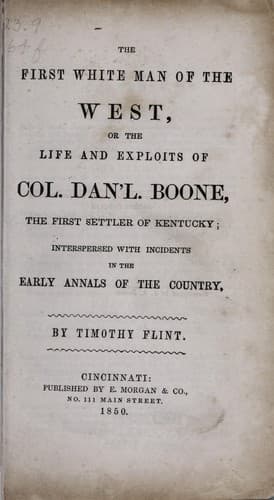
The First White Man of the West: Life and Exploits of Col. Dan'l. Boone, the First Settler of Kentucky;; Interspersed with Incidents in the Early Annals of the Country.Flint, Timothy
History
The First White Man of the West: Life and Exploits of Col. Dan'l. Boone, the First Settler of Kentucky;; Interspersed with Incidents in the Early Annals of the Country.
to be enabled to reach Boonesborough in safety.
At the close of the autumn of 1780, Kentucky, from being one county, was
divided into three, named Jefferson, Fayette, and Lincoln. William Pope,
Daniel Boone, and Benjamin Logan, were appointed to the important
offices of commanding the militia of their respective counties.
During this year Col. Clarke descended the Ohio, with a part of his
Virginia regiment, and after entering the Mississippi, at the first
bluff on the eastern bank, he landed and built Fort Jefferson. The
occupation of this fort, for the time, added the Chickasaws to the
number of hostile Indians that the western people had to encounter. It
was soon discovered, that it would be advisable to evacuate it, as a
mean of restoring peace. It was on their acknowleged territory. It had
been erected without their consent. They boasted it, as a proof of their
friendship, that they had never invaded Kentucky; and they indignantly
resented this violation of their territory. The evacuation of the fort
was the terms of a peace which the Chickasaws faithfully observed.
The winter of 1781, was one of unusual length and distress for the young
settlement of Kentucky. Many of the immigrants arrived after the close
of the hunting season; and beside, were unskilful in the difficult
pursuit of supplying themselves with game. The Indians had destroyed
most of the corn of the preceding summer, and the number of persons to
be supplied had rapidly increased. These circumstances created a
temporary famine, which, added to the severity of the season, inflicted
much severe suffering upon the settlement. Boone and Harrod were abroad,
breasting the keen forest air, and seeking the retreat of the deer and
buffalo, now becoming scarce, as the inhabitants multiplied. These
indefatigable and intrepid men supplied the hungry immigrants with the
flesh of buffaloes and deers; and the hardy settlers, accustomed to
privations, and not to over delicacy in their food, contented themselves
to live entirely on meat, until, in the ensuing autumn, they once more
derived abundance from the fresh and fertile soil.
In May, 1782, a body of savages assaulted Ashton's station, killed one
man, and took another prisoner. Captain Ashton, with twenty-five men,
pursued and overtook them. An engagement, which lasted two hours,
ensued. But the great superiority of the Indians in number, obliged
Captain Ashton to retreat. The loss of this intrepid party was severe.
Eight were killed, and four mortally wounded--their brave commander
being among the number of the slain. Four children were taken captive
from Major Hoy's station, in August following. Unwarned by the fate of
Captain Ashton's party. Captain Holden, with the inadequate force of
seventeen men, pursued the captors, came up with them, and were defeated
with the loss of four men killed, and one wounded.
Public-domain text, read in full here on John Shaqi.
Reviews
Reviews
No reviews yet
Be the first to share your thoughts on this work.
Elsewhere in the archive
Join the Discussion
Join the discussion
Sign in to leave a comment or review.
Sign InorCreate an account