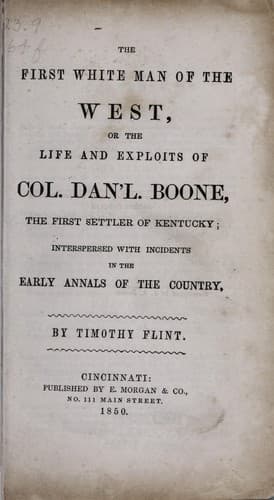
The First White Man of the West: Life and Exploits of Col. Dan'l. Boone, the First Settler of Kentucky;; Interspersed with Incidents in the Early Annals of the Country.Flint, Timothy
History
The First White Man of the West: Life and Exploits of Col. Dan'l. Boone, the First Settler of Kentucky;; Interspersed with Incidents in the Early Annals of the Country.
A singular spectacle was here presented in the case of a man by the name
of Netherland, who had been derided for his timidity. He was mounted on
a fleet and powerful horse, the back of which he had never left for a
moment. He was one of the first to recross the Licking. Finding himself
safe upon the opposite shore, a sentiment of sympathy came upon him as
he looked back and took a survey of the scene of murder going on in the
river and on its shore. Many had reached the river in a state of
faintness and exhaustion, and the Indians were still cutting them down.
Inspired with the feeling of a commander, he cried out in a loud and
authoritative voice, "Halt! Fire on the Indians. Protect the men in the
river." The call was obeyed. Ten or twelve men instantly turned, fired
on the enemy, and checked their pursuit for a moment, thus enabling some
of the exhausted and wounded fugitives to evade the tomahawk, already
uplifted to destroy them. The brave and benevolent Reynolds, whose reply
to Girty has been reported, relinquished his own horse to Colonel Robert
Patterson, who was infirm from former wounds, and was retreating on
foot. He thus enabled that veteran to escape. While thus signalizing his
disinterested intrepidity, he fell himself into the hands of the
Indians. The party that took him consisted of three. Two whites passed
him on their retreat. Two of the Indians pursued, leaving him under the
guard of the third. His captor stooped to tie his moccasin, and he
sprang away from him and escaped. It is supposed that one-fourth of the
men engaged in this action were commissioned officers. The whole number
engaged was one hundred and seventy-six. Of these, sixty were slain, and
eight made prisoners. Among the most distinguished names of those who
fell, were those of Colonels Todd and Trigg, Majors Harland and Bulger,
Captains Gordon and McBride, and a son of Colonel Boone. The loss of the
savages has never been ascertained. It could not have equalled that of
the assailants, though some supposed it greater. This sanguinary affair
took place August 19, 1782.
Public-domain text, read in full here on John Shaqi.
Reviews
Reviews
No reviews yet
Be the first to share your thoughts on this work.
Elsewhere in the archive
Join the Discussion
Join the discussion
Sign in to leave a comment or review.
Sign InorCreate an account