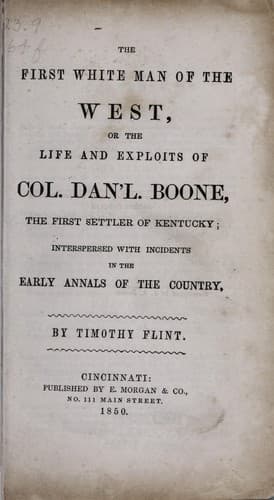
The First White Man of the West: Life and Exploits of Col. Dan'l. Boone, the First Settler of Kentucky;; Interspersed with Incidents in the Early Annals of the Country.Flint, Timothy
History
The First White Man of the West: Life and Exploits of Col. Dan'l. Boone, the First Settler of Kentucky;; Interspersed with Incidents in the Early Annals of the Country.
The terrible blow which the savages had struck at the Blue Licks,
excited a general and immediate purpose of retaliation through Kentucky.
General Clarke was appointed commander-in-chief, and Colonel Logan next
under him in command of the expedition, to be raised for that purpose.
The forces were to rendezvous at Licking. The last of September, 1782,
General Clarke, with one thousand men, marched from the present site of
Cincinnati, for the Indian towns on the Miami. They fell in on their
route with the camp of Simon Girty, who would have been completely
surprised with his Indians, had not a straggling savage espied the
advance, and reported it to them just in season to enable them to
scatter in every direction. They soon spread the intelligence that an
army from Kentucky was marching upon their towns.
As the army approached the towns on their route, they found that the
inhabitants had evacuated them, and fled into the woods. All the cabins
at Chillicothe, Piqua, and Willis were burned. Some skirmishing took
place, however, in which five Indians were killed, and seven made
prisoners, without any loss to the Kentuckians, save the wounding of one
man, which afterwards proved mortal. One distinguished Indian
surrendered himself, and was afterwards inhumanly murdered by one of the
troops, to the deep regret and mortification of General Clarke.
In October, 1785, Mr. McClure and family, in company with a number of
other families, were assailed on Skegg's creek. Six of the family were
killed, and Mrs. McClure, a child, and a number of other persons made
prisoners. The attack took place in the night. The circumstances of the
capture of Mrs. McClure, furnish an affecting incident illustrating the
invincible force of natural tenderness. She had concealed herself, with
her four children, in the brush of a thicket, which, together with the
darkness, screened her from observation. Had she chosen to have left her
infant behind, she might have escaped. But she grasped it, and held it
to her bosom, although aware that its shrieks would betray their covert.
The Indians, guided to the spot by its cries, killed the three larger
children, and took her and her infant captives. The unfortunate and
bereaved mother was obliged to accompany their march on an untamed and
unbroken horse.
Public-domain text, read in full here on John Shaqi.
Reviews
Reviews
No reviews yet
Be the first to share your thoughts on this work.
Elsewhere in the archive
Join the Discussion
Join the discussion
Sign in to leave a comment or review.
Sign InorCreate an account