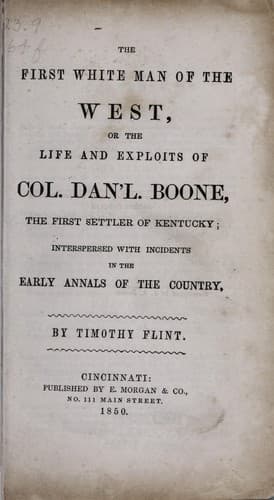
The First White Man of the West: Life and Exploits of Col. Dan'l. Boone, the First Settler of Kentucky;; Interspersed with Incidents in the Early Annals of the Country.Flint, Timothy
History
The First White Man of the West: Life and Exploits of Col. Dan'l. Boone, the First Settler of Kentucky;; Interspersed with Incidents in the Early Annals of the Country.
On the 13th of September, 1791, General Harmar marched from Fort
Washington, the present site of Cincinnati, with three hundred and
twenty regulars, and effected a junction with the militia of
Pennsylvania and Kentucky, which had advanced twenty-five miles in
front. The whole force amounted to one thousand four hundred and
fifty-three men. Col. Hardin, who commanded the Kentucky militia, was
detached with six hundred men, chiefly militia, to reconnoiter. On his
approach to the Indian settlements, the Indians set fire to their
villages and fled. In order, if possible, to overtake them, he was
detached with a smaller force, that could be moved more rapidly. It
consisted of two hundred and ten men. A small party of Indians met and
attacked them; and the greater part of the militia behaved
badly,--leaving a few brave men, who would not fly, to their fate.
Twenty-three of the party fell, and seven only made their escape and
rejoined the army. Notwithstanding this check, the army succeeded so far
as to reduce the remaining towns to ashes, and destroy their provisions.
On their return to Fort Washington, Gen. Harmar was desirous of wiping
off, in another action, the disgrace which public opinion had impressed
upon his arms. He halted eight miles from Chillicothe, and late at night
detached Col. Hardin, with orders to find the enemy, and bring them to
an engagement. Early in the morning this detachment reached the enemy,
and a severe engagement ensued. The savages fought with desperation.
Some of the American troops shrunk; but the officers conducted with
great gallantry. Most of them fell, bravely discharging their duty. More
than fifty regulars and one hundred militia, including the brave
officers, Fontaine, Willys, and Frothingham, were slain.
Harmar, in his official account of this affair, claimed the victory,
although the Americans seem clearly to have had the worst of it. At his
request, he was tried by a court martial, and honorably acquitted. The
enemy had suffered so severely, that they allowed him to return
unmolested to Fort Washington.
Public-domain text, read in full here on John Shaqi.
Reviews
Reviews
No reviews yet
Be the first to share your thoughts on this work.
Elsewhere in the archive
Join the Discussion
Join the discussion
Sign in to leave a comment or review.
Sign InorCreate an account