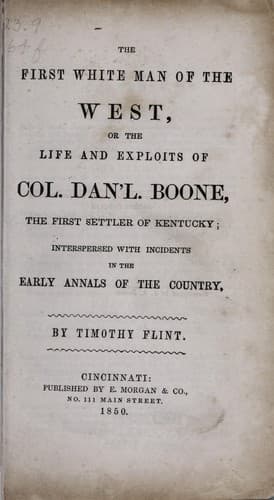
The First White Man of the West: Life and Exploits of Col. Dan'l. Boone, the First Settler of Kentucky;; Interspersed with Incidents in the Early Annals of the Country.Flint, Timothy
History
The First White Man of the West: Life and Exploits of Col. Dan'l. Boone, the First Settler of Kentucky;; Interspersed with Incidents in the Early Annals of the Country.
While thus engaged, he met with some persons who had returned from a
tour up the Missouri, who described to him the fine country bordering
upon that river. The vast prairies--the herds of buffaloes--the grizzly
bears--the beavers and otters; and above all, the ancient and unexplored
forests of that unknown region, fired his imagination, and produced at
once a resolve to remove there.
Accordingly, gathering up such useful articles of baggage as were of
light carriage, among which his trusty rifle was not forgotten, he
started with his family, driving his whole stock of cattle along with
him, on a pilgrimage to this new land of promise. He passed through
Cincinnati on his way thither in 1798. Being enquired of as to what had
induced him to leave all the comforts of home, and so rich and
flourishing a country as his dear Kentucky, which he had discovered, and
might almost call his own, for the wilds of Missouri? "Too much
crowded," replied he--"too crowded--I want more elbow room." He
proceeded about forty-five miles above St. Louis, and settled in what is
now St. Charles county. This country being still in the possession of
the French and Spanish, the ancient laws by which these territories were
governed were still in force there. Nothing could be more simple than
their whole system of administration. They had no constitution, no king,
no legislative assemblies, no judges, juries, lawyers, or sheriffs. An
officer, called the Commandant, and the priests, exercised all the
functions of civil magistrates, and decided the few controversies which
arose among these primitive in habitants, who held and occupied many
things in common. They suffered their ponies, their cattle, their swine,
and their flocks, to ramble and graze on the same common prairies and
pastures--having but few fences or inclosures, and possessing but little
of that spirit of speculation, enterprise, and money-making, which has
always characterized the Americans.
These simple laws and neighborly customs suited the peculiar habits and
temper of Boone. And as his character for honesty, courage, and fidelity
followed him there, he was appointed Commandant for the district of St.
Charles by the Spanish Commandant. He retained this command, and
continued to exercise the duties of his office with credit to himself,
and to the satisfaction of all concerned, until the government of the
United States went into effect.
CHAPTER XV.
Anecdotes of Colonel Boone, related by Mr. Audubon--A remarkable
instance of memory.
As an evidence of the development of backwoods skill, and a vivid
picture of Daniel Boone, we give the following from Mr. Audubon:
Public-domain text, read in full here on John Shaqi.
Reviews
Reviews
No reviews yet
Be the first to share your thoughts on this work.
Elsewhere in the archive
Join the Discussion
Join the discussion
Sign in to leave a comment or review.
Sign InorCreate an account