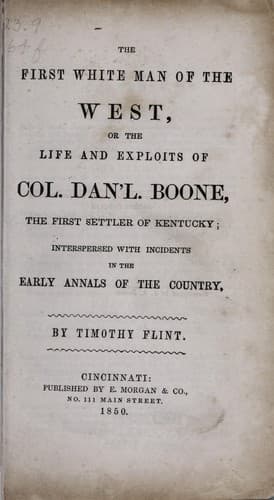
The First White Man of the West: Life and Exploits of Col. Dan'l. Boone, the First Settler of Kentucky;; Interspersed with Incidents in the Early Annals of the Country.Flint, Timothy
History
The First White Man of the West: Life and Exploits of Col. Dan'l. Boone, the First Settler of Kentucky;; Interspersed with Incidents in the Early Annals of the Country.
He was five feet ten inches in height, of a very erect, clean limbed,
and athletic form--admirably fitted in structure, muscle, temperament,
and habit, for the endurance of the labors, changes, and sufferings he
underwent. He had what phrenologists would have considered a model
head--with a forehead peculiarly high, noble, and bold--thin and
compressed lips--a mild, clear, blue eye--a large and prominent chin,
and a general expression of countenance in which fearlessness and
courage sat enthroned, and which told the beholder at a glance, what he
had been, and was formed to be.
We have only to add, that the bust of Boone, in Washington, the painting
of him ordered by the General Assembly of Missouri, and the engravings
of him in general, have--his family being judges--very little
resemblance. They want the high port and noble daring of his
countenance.
Though ungratefully requited by his country, he has left a name
identified with the history of Kentucky, and with the founders and
benefactors of our great republic. In all future time, and in every
portion of the globe; in history, in sculpture, in song, in
eloquence--the name of Daniel Boone will be recorded as the patriarch of
Backwoods Pioneers.
His name has already been celebrated by more than one poet. He is the
hero of a poem called the "MOUNTAIN MUSE," by our amiable countryman,
Bryan. He is supposed to be the original from which the inimitable
characters of LEATHER STOCKING, HAWKEYE, and the TRAPPER of the
PRAIRIES, in Cooper's novels, were drawn; and we will close these
memoirs, with the splendid tribute to the patriarch of backwoodsmen, by
the prince of modern poets, Lord Byron.
Of all men, saving Sylla, the man-slayer,
Who passes for in life and death most lucky,
Of the great names which in our faces stare,
The General Boone, backwoodsman of Kentucky,
Was happiest among mortals any where,
For killing nothing, but a bear or buck; he
Enjoy'd the lonely, vigorous, harmless days
Of his old age, in wilds of deepest maze.
Crime came not near him; she is not the child
Of solitude; health shrank not from him, for
Her home is in the rarely trodden wild,
Which, if men seek her not, and death be more
Their choice than life, forgive them, as beguil'd
By habit to what their own hearts abhor--
In cities cag'd. The present case in point I
Cite is, Boone liv'd hunting up to ninety:
And what is stranger, left behind a name,
For which men vainly decimate the throng;
Not only famous, but of that good fame,
Without which glory's but a tavern song;
Simple, serene, the antipodes of shame,
Which hate or envy e'er could tinge with wrong;
An active hermit; even in age the child
Of nature, or the Man of Ross run wild.
Public-domain text, read in full here on John Shaqi.
Reviews
Reviews
No reviews yet
Be the first to share your thoughts on this work.
Elsewhere in the archive
Join the Discussion
Join the discussion
Sign in to leave a comment or review.
Sign InorCreate an account