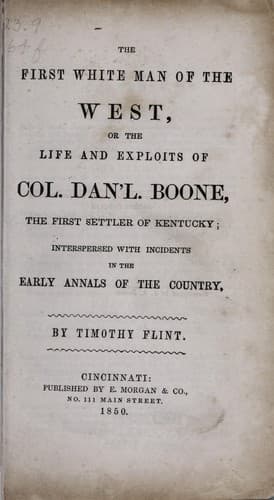
The First White Man of the West: Life and Exploits of Col. Dan'l. Boone, the First Settler of Kentucky;; Interspersed with Incidents in the Early Annals of the Country.Flint, Timothy
History
The First White Man of the West: Life and Exploits of Col. Dan'l. Boone, the First Settler of Kentucky;; Interspersed with Incidents in the Early Annals of the Country.
This adventure did not deter him from exposing himself in a similar way
again. He was once more hunting for the salt makers, when, on the
seventh day of February following, he came in view of a body of one
hundred and two Indians, evidently on their march to the assault of
Boonesborough--that being a particular mark for Indian revenge. They
were in want of a prisoner, from whom to obtain intelligence, and Boone
was the person of all others whom they desired. He fled; but among so
many warriors, it proved, that some were swifter of foot than himself,
and these overtook him and made him prisoner.
By a tedious and circuitous march they brought him back to the Blue
Licks, and took their measures with so much caution, as to make
twenty-seven of the thirty salt makers prisoners. Boone obtained for
them a capitulation, which stipulated, that their lives should be
spared, and that they should be kindly treated. The fortunate three,
that escaped, had just been sent home with the salt that had been made
during their ill-fated expedition.
The Indians were faithful to the stipulations of the capitulation; and
treated their prisoners with as much kindness both on their way, and
after their arrival at Chillicothe, as their habits and means would
admit. The march was rapid and fatiguing, occupying three days of
weather unusually cold and inclement.
The captivity of twenty-eight of the select and bravest of the Kentucky
settlers, without the hope of liberation or exchange, was a severe blow
to the infant settlement. Had the Indians, after this achievement,
immediately marched against Boonesborough, so materially diminished in
its means of defence, they might either have taken the place by
surprise, or, availing themselves of the influence which the possession
of these prisoners gave them over the fears and affections of the
inmates, might have procured a capitulation of the fort. Following up
this plan in progression, the weaker station would have followed the
example of Boonesborough; since it is hardly supposable, that the
united influence of fear, example, and the menace of the massacre of so
many prisoners would not have procured the surrender of all the rest.
But, though on various occasions they manifested the keenest
observation, and the acutest quickness of instinctive cunning--though
their plans were generally predicated on the soundest reason, they
showed in this, and in all cases, a want of the combination of thought,
and the abstract and extended views of the whites on such occasions. For
a single effort, nothing could be imagined wiser than their views. For a
combination made up of a number of elements of calculation, they had no
reasoning powers at all.
Public-domain text, read in full here on John Shaqi.
Reviews
Reviews
No reviews yet
Be the first to share your thoughts on this work.
Elsewhere in the archive
Join the Discussion
Join the discussion
Sign in to leave a comment or review.
Sign InorCreate an account