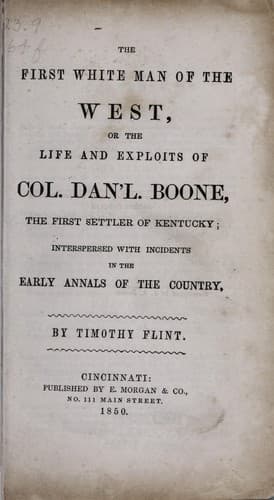
The First White Man of the West: Life and Exploits of Col. Dan'l. Boone, the First Settler of Kentucky;; Interspersed with Incidents in the Early Annals of the Country.Flint, Timothy
History
The First White Man of the West: Life and Exploits of Col. Dan'l. Boone, the First Settler of Kentucky;; Interspersed with Incidents in the Early Annals of the Country.
This town was inhabited by the Shawnese, and Boone was placed in a most
severe school, in which to learn Indian modes and ceremonies, by being
himself the subject of them. On the return of the party that led him to
their home, he learned that some superstitious scruple induced them to
halt at mid-day when near their village, in order to solemnize their
return by entering their town in the evening. A runner was despatched
from their halting place to instruct the chief and the village touching
the material incidents of their expedition.
Before the expedition made the triumphal entry into their village, they
clad their white prisoner in a new dress, of material and fashion like
theirs. They proceeded to shave his head and skewer his hair after their
own fashion, and then rouged him with a plentiful smearing of vermilion
and put into his hand a white staff, gorgeously tasselated with the
tails of deer. The war-captain or leader of the expedition gave as many
yells as they had taken prisoners and scalps. This operated as
effectually as ringing a tocsin, to assemble the whole village round
the camp. As soon as the warriors from the village appeared, four young
warriors from the camp, the two first carrying each a calumet,
approached the prisoner, chanting a song as they went, and taking him by
the arm, led him in triumph to the cabin, where he was to remain until
the announcement of his doom. The resident in this cabin, by their
immemorial usage, had the power of determining his fate, whether to be
tortured and burnt at the stake, or adopted into the tribe.
The present occupant of the cabin happened to be a woman, who had lost a
son during the war. It is very probable that she was favorably impressed
towards him by noting his fine person, and his firm and cheerful
visage--circumstances which impress the women of the red people still
more strongly than the men. She contemplated him stedfastly for some
time, and sympathy and humanity triumphed, and she declared that she
adopted him in place of the son she had lost. The two young men, who
bore the calumet, instantly unpinioned his hands, treating him with
kindness and respect. Food was brought him, and he was informed that he
was considered as a son, and she, who had adopted him, as his mother. He
was soon made aware, by demonstrations that could not be dissembled or
mistaken, that he was actually loved, and trusted, as if he really were,
what his adoption purported to make him. In a few days he suffered no
other penalty of captivity than inability to return to his family. He
was sufficiently instructed in Indian customs to know well, that any
discovered purpose or attempt to escape would be punished with instant
death.
Public-domain text, read in full here on John Shaqi.
Reviews
Reviews
No reviews yet
Be the first to share your thoughts on this work.
Elsewhere in the archive
Join the Discussion
Join the discussion
Sign in to leave a comment or review.
Sign InorCreate an account