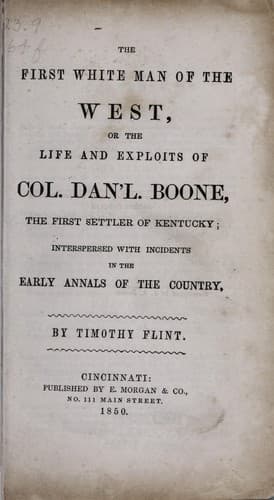
The First White Man of the West: Life and Exploits of Col. Dan'l. Boone, the First Settler of Kentucky;; Interspersed with Incidents in the Early Annals of the Country.Flint, Timothy
History
The First White Man of the West: Life and Exploits of Col. Dan'l. Boone, the First Settler of Kentucky;; Interspersed with Incidents in the Early Annals of the Country.
be considered as a living one, and she is allowed to cheer her depressed
spirits with a double dram, that of her budget-husband and her own.
After a full year of this penance with the budget-husband, she is
allowed to exchange it for a living one, if she can find him.
When an Indian party forms for private revenge the object is
accomplished in the following manner. The Indian who seeks revenge,
proposes his project to obtain it to some of his more intimate
associates, and requests them to accompany him. When the requisite
number is obtained, and the plan arranged it is kept a profound secret
from all others, and the proposer of the plan is considered the leader.
The party leaves the village secretly, and in the night. When they halt
for the night, the eldest encamp in front, and the younger in the rear.
The foremen hunt for the party, and perform the duty of spies. The
latter cook, make the fires, mend the moccasins, and perform the other
drudgery of the expedition.
Every war party has a small budget, called the _war budget_, which
contains something belonging to each one of the party, generally
representing some animal; for example, the skin of a snake, the tail of
a buffalo, the skin of a martin, or the feathers of some extraordinary
bird. This budget is considered a sacred deposit, and is carried by some
person selected for the purpose, who marches in front, and leads the
party against the enemy. When the party halts, the budget is deposited
in front, and no person passes it without authority. No one, while such
an exhibition is pending, is allowed to lay his pack on a log, converse
about women or his home. When they encamp, the heart of whatever beast
they have killed on the preceding day is cut into small pieces and
burnt. No person is allowed, while it is burning, to step across the
fire, but must go round it, and always in the direction of the sun.
When an attack is to be made, the war budget is opened, and each man
takes out his budget, or _totem_, and attaches it to that part of his
body which has been indicated by tradition from his ancestors. When the
attack is commenced, the body of the fighter is painted, generally
black, and is almost naked. After the action, each party returns his
_totem_ to the commander of the party, who carefully wraps them all up,
and delivers them to the man who has taken the first prisoner or scalp;
and he is entitled to the honor of leading the party home in triumph.
The war budget is then hung in front of the door of the person who
carried it on the march against the enemy, where it remains suspended
thirty or forty days, and some one of the party often sings and dances
round it.
Public-domain text, read in full here on John Shaqi.
Reviews
Reviews
No reviews yet
Be the first to share your thoughts on this work.
Elsewhere in the archive
Join the Discussion
Join the discussion
Sign in to leave a comment or review.
Sign InorCreate an account