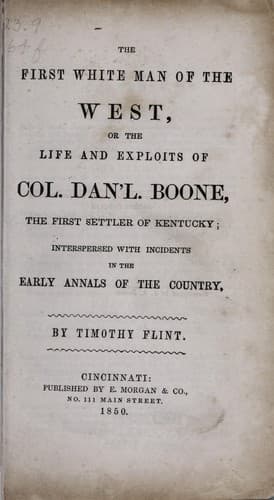
The First White Man of the West: Life and Exploits of Col. Dan'l. Boone, the First Settler of Kentucky;; Interspersed with Incidents in the Early Annals of the Country.Flint, Timothy
History
The First White Man of the West: Life and Exploits of Col. Dan'l. Boone, the First Settler of Kentucky;; Interspersed with Incidents in the Early Annals of the Country.
During Boone's captivity among the Shawnese, they took prisoner a noted
warrior of a western tribe, with which they were then at war. He was
condemned to the stake with the usual solemnities. Having endured the
preliminary tortures with the most fearless unconcern, he told them,
when preparing to commence a new series, with a countenance of scorn, he
could teach them how to make an enemy eat fire to some purpose; and
begged that they would give him an opportunity, together with a pipe and
tobacco. In respectful astonishment, at an unwonted demonstration of
invincible endurance, they granted his request. He lighted his pipe,
began to smoke, and sat down, all naked as he was, upon the burning
torches, which were blazing within his circle. Every muscle of his
countenance retained its composure. On viewing this, a noted warrior
sprang up, exclaiming, that this was a true warrior; that though his
nation was treacherous, and he had caused them many deaths, yet such was
their respect for true courage, that if the fire had not already spoiled
him, he should be spared. That being now impossible, he promised him the
merciful release of the tomahawk. He then held the terrible instrument
suspended some moments over his head, during all which time he was
seen neither to change his posture, move a muscle, or his countenance to
blench. The tomahawk fell, and the impassable warrior ceased to suffer.
[Illustration]
We shall close these details of the Shawnese customs, at the time when
Boone was prisoner among them, by giving his account of their ceremonies
at making peace. The chief warriors, who arrange the conditions of the
peace and subsequent friendship, first mutually eat and smoke together.
They then pledge each other in the sacred drink called _Cussena_. The
Shawnese then wave large fans of eagles' tails, and conclude with a
dance. The stranger warriors, who have come to receive the peace, select
half a dozen of their most active young men, surmounting their crowns
with swan's feathers, and painting their bodies with white clay. They
then place their file leader on the consecrated seat of what imports in
their language, the "beloved cabin." Afterwards they commence singing
the peace song, with an air of great solemnity. They begin to dance,
first in a prone or bowing posture. They then raise themselves erect,
look upwards, and wave their eagles' tails towards the sky, first with a
slow, and then with a quick and jerky motion. At the same time, they
strike their breast with a calabash fastened to a stick about a foot in
length, which they hold in their left hand, while they wave the eagles'
feathers with the right, and keep time by rattling pebbles in a gourd.
These ceremonies of peace-making they consider among their most solemn
duties; and to be perfectly accomplished in all the notes and gestures
is an indispensable acquirement to a thorough trained warrior.
Public-domain text, read in full here on John Shaqi.
Reviews
Reviews
No reviews yet
Be the first to share your thoughts on this work.
Elsewhere in the archive
Join the Discussion
Join the discussion
Sign in to leave a comment or review.
Sign InorCreate an account