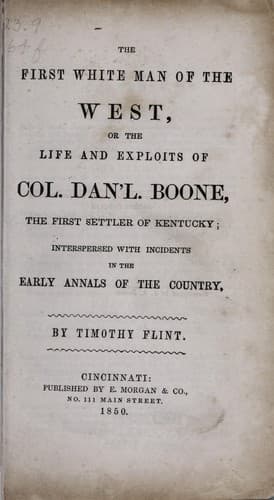
The First White Man of the West: Life and Exploits of Col. Dan'l. Boone, the First Settler of Kentucky;; Interspersed with Incidents in the Early Annals of the Country.Flint, Timothy
History
The First White Man of the West: Life and Exploits of Col. Dan'l. Boone, the First Settler of Kentucky;; Interspersed with Incidents in the Early Annals of the Country.
When the fast and purification was complete, they were compelled to set
forth, prepared or unprepared, be the weather fair or foul. Accordingly,
when the time arrived, they fired their guns, whooped, and danced, and
sung--and continued firing their guns before them on the commencement of
their route. The leading war-chief marched first, carrying their
medicine bag, or budget of holy things. The rest followed in Indian
file, at intervals of three or four paces behind each other, now and
then chiming the war-whoop in concert.
They advanced in this order until they were out of sight and hearing of
the village. As soon as they reached the deep woods, all became as
silent as death. This silence they inculcate, that their ears may be
quick to catch the least portent of danger.
Every one acquainted with the race, has remarked their intense keenness
of vision. Their eyes, for acuteness, and capability of discerning
distant objects, resemble those of the eagle or the lynx; and their
cat-like tread among the grass and leaves, seems so light as scarcely to
shake off the dew drops. Thus they advance on their expedition rapidly
and in profound silence, unless some one of the party should relate that
he has had an unpropitious dream When this happens, an immediate arrest
is put upon the expedition, and the whole party face about, and return
without any sense of shame or mortification. A whole party is thus often
arrested by a single person; and their return is applauded by the tribe,
as a respectful docility to the divine impulse, as they deem it, from
the Great Spirit. These dreams are universally reverenced, as the
warnings of the guardian spirits of the tribe. There is in that country
a sparrow, of an uncommon species, and not often seen. This bird is
called in the Shawnese dialect by a name importing "kind messenger,"
which they deem always a true omen, whenever it appears, of bad news.
They are exceedingly intimidated whenever this bird sings near them; and
were it to perch and sing over their war-camp, the whole party would
instantly disperse in consternation and dismay.
Every chief has his warrior, Etissu, or waiter, to attend on him and his
party. This confidential personage has charge of every thing that is
eaten or drank during the expedition. He parcels it out by rules of
rigid abstemiousness. Though each warrior carries on his back all his
travelling conveniences, and his food among the rest, yet, however keen
the appetite sharpened by hunger, however burning the thirst, no one
dares relieve his hunger or thirst, until his rations are dispensed to
him by the Etissu.
Boone had occasion to have all these rites most painfully impressed on
his memory; for he was obliged to conform to them with the rest. One
single thought occupied his mind--to seize the right occasion to escape.
Public-domain text, read in full here on John Shaqi.
Reviews
Reviews
No reviews yet
Be the first to share your thoughts on this work.
Elsewhere in the archive
Join the Discussion
Join the discussion
Sign in to leave a comment or review.
Sign InorCreate an account