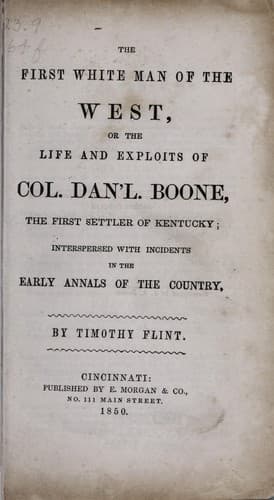
The First White Man of the West: Life and Exploits of Col. Dan'l. Boone, the First Settler of Kentucky;; Interspersed with Incidents in the Early Annals of the Country.Flint, Timothy
History
The First White Man of the West: Life and Exploits of Col. Dan'l. Boone, the First Settler of Kentucky;; Interspersed with Incidents in the Early Annals of the Country.
At the Blue Licks, a place of evil omen to Kentucky, eleven of the men,
anxious for the safety of the families they had left behind and deeming
their force too small for the object contemplated, abandoned the
enterprise and retreated to the fort. The remaining nineteen, not
discouraged by the desertion of their companions, heroically persevered.
They crossed the Ohio to the present site of Cincinnati, on rafts. They
then painted their faces, and in other respects assumed the guise and
garb of savages, and marched upon the Indian towns.
When arrived within twenty miles of these towns they met the force with
which Boone had set out. Discouraged by his escape, the original party
had returned, had been rejoined by a considerable reinforcement, the
whole amounting to two hundred and fifty men on horse-back, and were
again on their march against Boonesborough. Fortunately, Major Smith and
his small party discovered this formidable body before they were
themselves observed. But instead of endeavoring to make good their
retreat from an enemy so superior in numbers, and mounted upon horses,
they fired upon them and killed two of their number. An assault so
unexpected alarmed the Indians; and without any effort to ascertain the
number of their assailants, they commenced a precipitate retreat. If
these rash adventurers had stopped here, they might have escaped
unmolested. But, flushed with this partial success, they rushed upon the
retreating foe, and repeated their fire. The savages, restored to
self-possession, halted in their turn, deliberated a moment, and turned
upon the assailants. Major Smith, perceiving the imprudence of having
thus put the enemy at bay, and the certainty of the destruction of his
little force, if the Indians should perceive its weakness, ordered a
retreat in time; and being considerably in advance of the foe, succeeded
in effecting it without loss. By a rapid march during the night, in the
course of the next morning they reached Boonesborough in safety.
Scarcely an hour after the last of their number had entered the fort, a
body of six hundred Indians, in three divisions of two hundred each,
appeared with standards and much show of warlike array, and took their
station opposite the fort. The whole was commanded by a Frenchman named
Duquesne. They immediately sent a flag requesting the surrender of the
place, in the name of the king of Great Britain. A council was held, and
contrary to the opinion of Major Smith, it was decided to pay no
attention to the proposal. They repeated their flag of truce, stating
that they had letters from the commander at Detroit to Colonel Boone. On
this, it was resolved that Colonel Boone and Major Smith should venture
out, and hear what they had to propose.
Public-domain text, read in full here on John Shaqi.
Reviews
Reviews
No reviews yet
Be the first to share your thoughts on this work.
Elsewhere in the archive
Join the Discussion
Join the discussion
Sign in to leave a comment or review.
Sign InorCreate an account