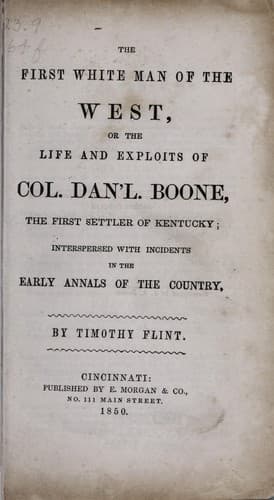
The First White Man of the West: Life and Exploits of Col. Dan'l. Boone, the First Settler of Kentucky;; Interspersed with Incidents in the Early Annals of the Country.Flint, Timothy
History
The First White Man of the West: Life and Exploits of Col. Dan'l. Boone, the First Settler of Kentucky;; Interspersed with Incidents in the Early Annals of the Country.
They then procured a quantity of combustible matter, set fire to it, and
approached under covert of the darkness, so near the palisades as to
throw the burning materials into the fort. But the inmates had availed
themselves of the two days' consultation, granted them by the
treacherous foe, to procure an ample supply of water; and they had the
means of extinguishing the burning faggots as they fell.
Finding their efforts to fire the fort ineffectual, they returned again
to their arms, and continued to fire upon the station for some days.
Taught a lesson of prudence, however, by what had already befallen them,
they kept at such a cautious distance, as that their fire took little
effect. A project to gain the place, more wisely conceived, and
promising better success, was happily discovered by Colonel Boone. The
walls of the fort were distant sixty yards from the Kentucky river. The
bosom of the current was easily discernible by the people within. Boone
discovered in the morning that the stream near the shore was extremely
turbid. He immediately divined the cause.
The Indians had commenced a trench at the water level of the river
bank, mining upwards towards the station, and intending to reach the
interior by a passage under the wall. He took measures to render their
project ineffectual, by ordering a trench to be cut inside the fort,
across the line of their subterraneous passage. They were probably
apprised of the countermine that was digging within, by the quantity of
earth thrown over the wall. But, stimulated by the encouragement of
their French engineer, they continued to advance their mine towards the
wall, until, from the friability of the soil through which it passed, it
fell in, and all their labor was lost. With a perseverance that in a
good cause would have done them honor, in no wise discouraged by this
failure to intermit their exertions, they returned again to their fire
arms, and kept up a furious and incessant firing for some days, but
producing no more impression upon the station than before.
During the siege, which lasted eight days, they proposed frequent
parleys, requesting the surrender of the place, and professing to treat
the garrison with the utmost kindness. They were answered, that they
must deem the garrison to be still more brutally fools than themselves,
to expect that they would place any confidence in the proposals of
wretches who had already manifested such base and stupid treachery. They
were bidden to fire on, for that their waste of powder and lead gave the
garrison little uneasiness, and were assured that they could not hope
the surrender of the place, while there was a man left within it. On the
morning of the ninth day from the commencement of the siege, after
having, as usual, wreaked their disappointed fury upon the cattle and
swine, they decamped, and commenced a retreat.
Public-domain text, read in full here on John Shaqi.
Reviews
Reviews
No reviews yet
Be the first to share your thoughts on this work.
Elsewhere in the archive
Join the Discussion
Join the discussion
Sign in to leave a comment or review.
Sign InorCreate an account